Menu
Brest Hero Fortress celebrates the 55th anniversary of the opening of the memorial complex.
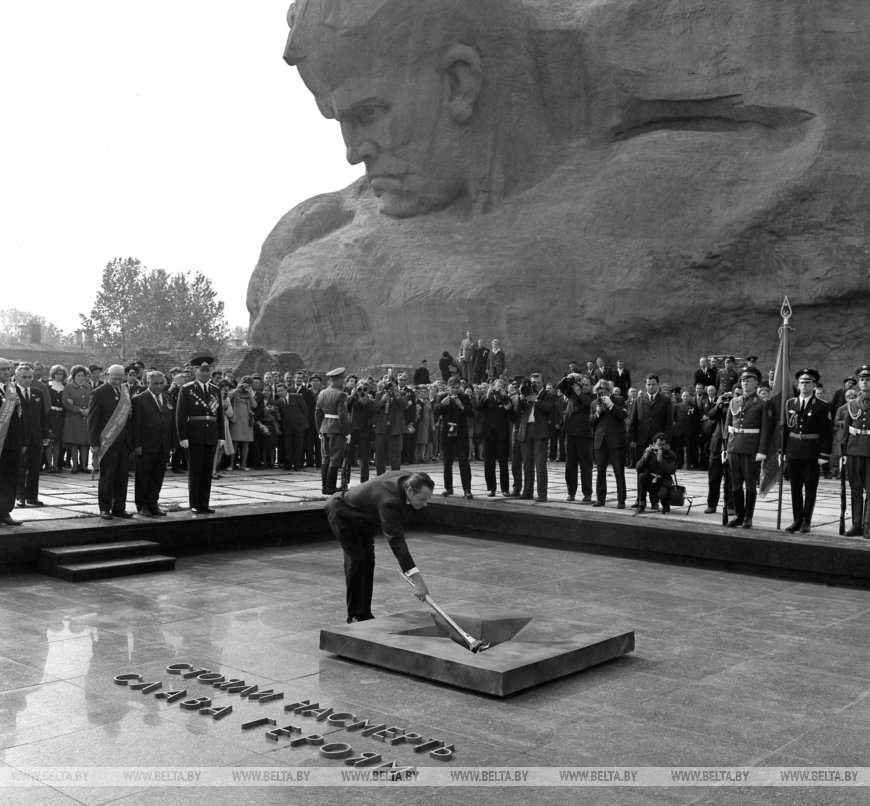
This year marks the 55th anniversary of the opening of the Brest Fortress-Hero memorial complex. The legendary citadel on the Bug River, which in June 1941 became a stronghold of resistance against Nazi German invaders, today stands as a symbol of unbroken spirit, steadfastness, and heroism of Soviet soldiers. Over the past decades, the memorial complex has become a world-renowned center for preserving historical truth and patriotic education.
The solemn opening of the complex took place on September 25, 1971. More than 600 veterans of the Brest garrison of 1941 participated, including defenders of the fortress and relatives of the fallen. On the same day, the Eternal Flame was lit.
The Brest Fortress-Hero memorial complex immortalizes the feat of its defenders during the heroic defense in June–July 1941. In the first hours of the war, the garrison was cut off from the main forces of the Red Army, yet it put up fierce resistance against superior enemy forces. The defense lasted about a month under conditions of complete encirclement, shortage of ammunition, food, and water. The steadfastness of the fortress defenders became one of the first symbols of the forthcoming Victory.
The memorial complex is one of the most recognizable and visited tourist attractions in Belarus. Having been built as a military facility and having survived the fires of world wars, the fortress today remains a place of memory and peace. In a unified ensemble, it combines battle sites, ruins, surviving fortress structures, sculptural compositions, and museum exhibits. At present, the Brest Fortress-Hero memorial complex and the fortification structures complex of Brest Fortress are included in the State List of
Every compositional element of the architectural and artistic ensemble carries a significant semantic load and exerts a strong emotional impact.
The main entrance of Brest Fortress is a monumental arch in the form of a huge five-pointed star carved into a concrete block. The structure is supported by the slope of the fortress rampart. The walls of the passage are faced with polished dark granite, which contrasts with the protruding ruins of the casemates in the opening. This architectural solution is intended to create a deep visual and emotional-psychological effect for everyone who crosses the threshold of the citadel.
The compositional center of the ensemble is the monument "Courage" – a generalized image of a victorious warrior and a banner. It is a huge sculpture in size, consisting of 200 parts. The 100‑meter bayonet‑obelisks are visible from any point of the fortress and are linked to the main monument "Courage" by three rows of tombstones. On the rear side of the monument are bas-reliefs depicting episodes of the fortress's defense in 1941.
Near the ruins of the former Engineering Administration burns the Eternal Flame. Not far from it is a memorial area of the Hero Cities of the Soviet Union. Beneath the granite slabs bearing the image of the "Gold Star" medal are capsules
On June 22, 2011, the sculptural composition To the Heroes of the Border, to Women and Children Who Stepped Into Immortality With Their Courage was solemnly unveiled. The site chosen for the sculpture was the area near the Terespol Gates, where, under the command of Lieutenant A. Kizhevatov, head of the 9th border outpost, the border guards stood to the death.
In January 2021, the memorial's team received a diploma as a laureate of the special prize of the President of Belarus for figures in culture and art for a significant contribution to preserving the historical truth about the Great Patriotic War, and for the implementation of the Union State project Capital Repair,