Menu
Belarus ranks among the top 10 producers of synthetic diamonds. Experts explained why they are needed.
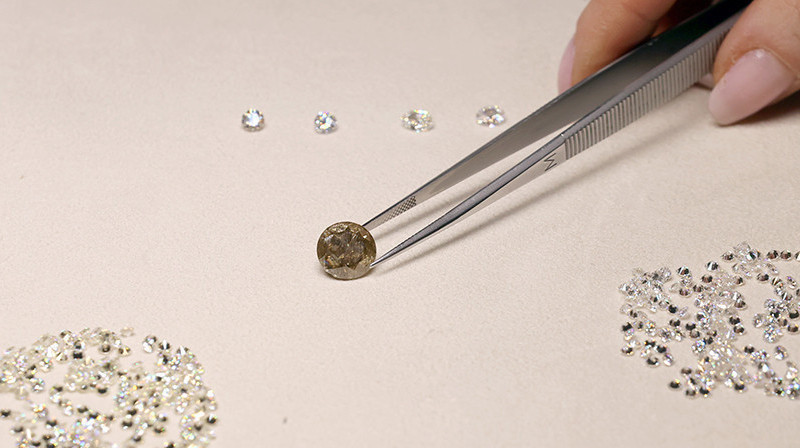
What the marking on jewelry made of precious metals is for, who can distinguish an artificially grown diamond from a natural one, and how the jewelry trade‑in works in Belarus were explained by experts on the program “Economic Environment” on the “Belarus 1” television channel.
Speaking about the industry as a whole, the program participants noted that its development is receiving attention at a high level. “The jewelry sector in Belarus is a dynamically developing part of the economy that combines state regulation and private initiative. From the perspective of the law “On Precious Metals and Precious Stones,” this sphere of activity covers not only the manufacture and sale of jewelry, but also the mining of precious metals, processing, use, and circulation. Everything related to precious metals is a licensed activity. We have 34 licensees with the right to produce jewelry, and about 111 licensees with the right to sell jewelry,” explained Belarus’ Deputy Minister of Finance Alexander Sudnik.
He reminded that since January 1 the republic has introduced mandatory marking of jewelry. “In 10 months we have about 1.9 million marked jewelry items, of which about 75 % have already been purchased,” the deputy minister noted.
Alexander Sudnik emphasized that one of the main tasks facing the jewelry industry is the purchase of scrap jewelry that is in circulation among Belarusians and ensuring its further use in industry and transfer to jewelry production. Another goal is to export domestic jewelry products abroad. He said that recently the number and variety of jewelry items entering the retail network have been increasing, indicating the steady development of the sector.
After visiting one of the flagship enterprises of the jewelry industry, the head of state set the task of producing world‑class products. How this directive is implemented in practice was explained by the deputy general director for production of JSC “Gomel Plant ‘Crystal’” – the management company of the “Crystal Holding” holding, Yuri Dedov.
We carried out a substantial modernization of the diamond processing plant over the past five years, modernized and partially eliminated manual labor, moved to better cutting quality, and improved a number of technological aspects in determining diamond raw material upon arrival, because the entire diamond raw material base that comes to the enterprise undergoes 100 % quality control. At the same time we raised the level of the laboratory that today determines the quality of diamonds at the output. The enterprise also significantly modernized jewelry production, entered new product lines such as measuring ingots and coins, he explained.
Yuri Dedov emphasized that the enterprise processes only natural diamonds, with no plans to work with synthetic equivalents.
Deputy General Director of the Scientific and Practical Center of the National Academy of Sciences of Belarus in Materials Science, Oleg Ignatenko, noted that Belarus is among the top ten countries in the world that cultivate diamonds. Why is this done? Primarily due to the price factor. For example, a pink diamond on the world market can cost up to $2.5 million per carat, while one grown in artificial conditions costs only 2–4 % of that amount.
"A non‑professional cannot distinguish natural from synthetic stone in a piece. Whether it is natural or synthetic, it is impossible to tell by eye," he said and explained where artificial diamonds are used. "It is an ultra‑hard material. It is used in tooling, jewelry, and electronics." At the same time, the quality of synthetic materials, according to him, is comparable to natural ones.
Alexander Sudnik spoke about the experience of neighboring countries. In Russia, there has been a recent trend toward banning the use of synthetic precious stones in jewelry production. At the same time, he emphasized that Belarusians value and prefer natural diamonds the most.
Yuri Dedov pointed out that in Belarus there are state standards requiring manufacturers to indicate on tags all stone inclusions in jewelry, so buyers can see what they are purchasing. For example, the weight of natural diamonds is always indicated in carats, while synthetic ones are in grams. And by the way, all the full information is now also contained in a QR code on the tag attached to the jewelry, so with a phone you can find out in detail what a person holds in their hands.
Experts noted that the main supplier of diamond raw material for Belarusian producers is Russian companies. Regarding precious metals, Alexander Sudnik informed that the so‑called trade‑in is gaining momentum, where citizens hand in old jewelry and, with an additional payment, acquire new pieces. Metals from the state fund, which supplies the needs of industry, science, and the jewelry sector, are also being used.
Partner material