Menu
Attention: main pipeline transport!
For most people, the term "pipeline" is associated with water supply and gas supply systems, through which water and domestic gas are delivered to residential buildings. However, besides the well-known pipelines, there are pipelines intended for the transportation of crude oil, petroleum products, and gas – mainline pipeline transport. They, as a rule, are hidden underground or underwater.
Transportation of oil, petroleum products, and gas by road, rail, or water transport over long distances is associated with certain risk and significant material costs. Mainline pipelines simplify the transportation of raw materials from their extraction sites to end consumers.
In order to ensure industrial and environmental safety on main pipelines intended for the transportation of liquid or gaseous hydrocarbons, in accordance with the Regulation on the Procedure for Establishing Protective Zones of Main Pipeline, Their Sizes and Regime of Use (approved by the Resolution of the Council of Ministers of the Republic of Belarus dated 21 November 2022 No. 800), the operator establishes a protective zone with respect to:
- a main pipeline transporting product – on a land plot situated between parallel planes at a distance of not less than 50 meters on each side from the axis of the main pipeline;
- two or more main pipelines transporting product laid in a single technical corridor – on a land plot situated between parallel planes at a distance of not less than 50 meters on each side from the axis of the outermost main pipeline on each side of the technical corridor;
- an underwater crossing of main pipelines – on a water area section from the water surface to the bottom, situated between parallel planes at a distance of not less than 100 meters from the axis of the outermost pipelines on each side;
- pumping (transfer), compressor, gas distribution, gas measurement stations, gas cooling station, liquid hydrocarbon transshipment facility of the main pipeline, tank farm of main pipeline facilities, liquid and gaseous hydrocarbon metering unit, liquid hydrocarbon receipt and delivery points, oil heating points, loading or unloading trestle, area with a compressor station at an underground gas hydrocarbon storage facility – on a land plot bounded by a closed line at a distance of not less than 100 meters from the boundary of the respective facility's territory in all directions;
- containers for storage and degassing of condensate, earthen barn for emergency discharge of liquid hydrocarbons – on a land plot bounded by a closed line at a distance of not less than 50 meters from the boundary of the respective facility's territory in all directions.
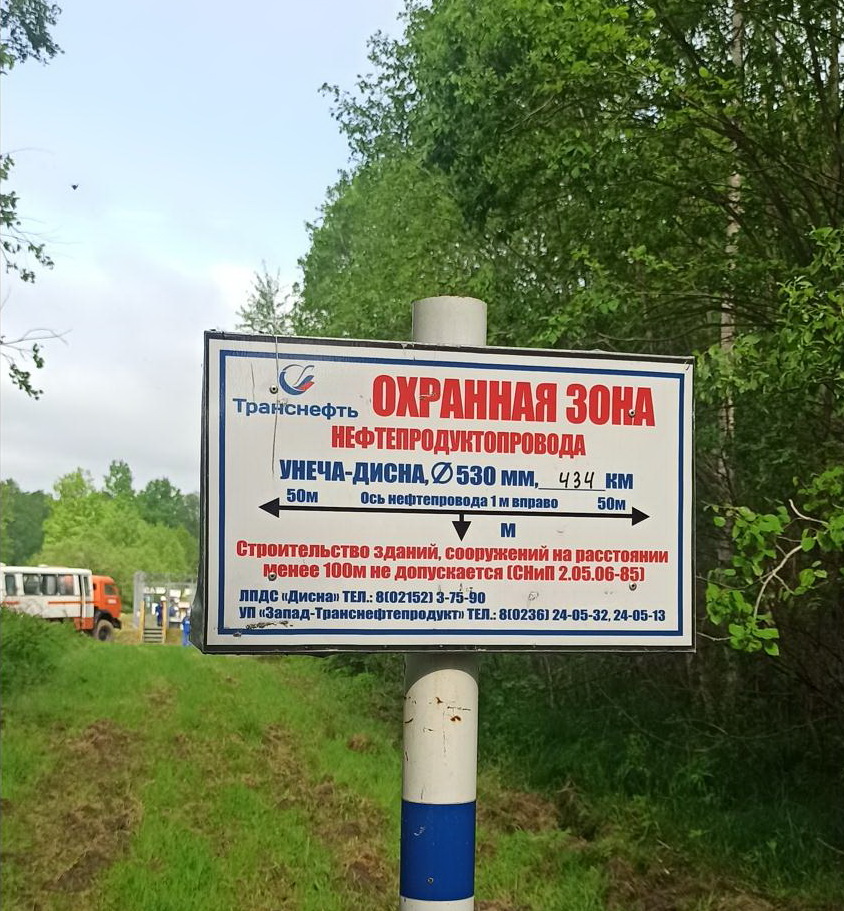
The dimensions of the protective zone, the name of the main pipeline, the linkage of the sign (kilometre) to the pipeline route, the telephone numbers and address of the operator's dispatch service operating this pipeline section are indicated on an information plate placed on identification posts.
Identification poles 1.5–2 meters high with an information plate are installed by the operator on the axis of the main pipeline:
- on straight sections of the route within visibility, but not less frequently than every 500 meters;
- at bends of the main pipeline (three poles);
- at locations where the main pipeline crosses other above-ground and underground utilities;
- at locations where the main pipeline crosses water obstacles, ravines, channels;
- at locations of repair and restoration work;
- to mark locations of test pits, washouts, and emergences of the main pipeline;
- on multi-line main pipelines, each line must be marked;
- at locations where the main pipeline crosses roads of all categories, according to the operator's information, the road owner installs and operates road signs prohibiting stopping of vehicles.
Any work and actions in the protection zones of main pipelines are carried out in accordance with legislation on main pipeline transport.
In protected zones it is prohibited to:
- move, bury, damage identification and signal signs, control and measurement points, erect any buildings and structures not related to the main pipeline;
- enter the territory or open manholes, gates and doors of unattended booster stations of communication cable lines, block-boxes of telemetry systems, fences of line hardware nodes, radio relay stations, cathodic and drainage protection stations, line and inspection wells and other line devices, buildings and structures of main pipelines, open and close valves and gates, disconnect or connect power supply and telemetry means of main pipelines;
- arrange dumps, dump solutions of acids, salts and alkalis;
- destroy bank reinforcement structures, water passage devices, earthen and other structures (devices) protecting main pipelines from destruction, and the adjacent territory and surrounding area – from accidental spillage of transported product;
- drop anchors, pass with anchors dropped, chains, logs, drags and trawls, carry out dredging and earth excavation works;
- light fires and place open or closed sources of fire;
- carry out unauthorized excavations and earthworks, as well as perform actions that may disrupt the operation of main pipelines, means of technological communication and telemetry or lead to their damage;
- arrange recreation areas, tourist stops and camps, public transport stops, wind power installations, transport interchanges, industrial gardens;
- stockpile fodder, fertilizers, materials