Menu
An advertiser became a millionaire by selling ordinary stones instead of pets. How did this happen?
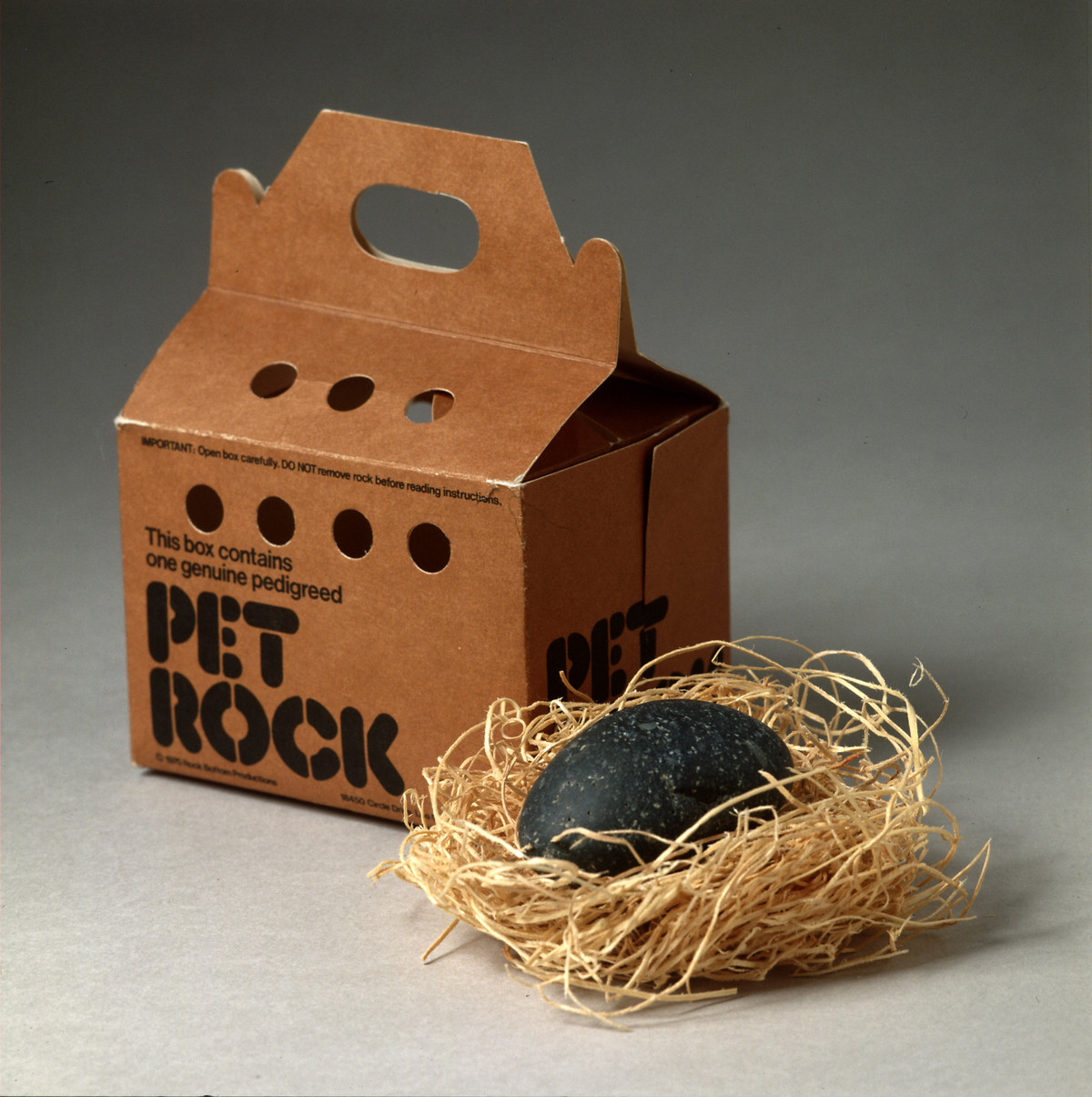
On the eve of Christmas in 1975, American department stores were swept by a strange fever: buyers were grabbing cardboard boxes with air holes from the shelves, inside which, on wood shavings, lay an ordinary gray stone. The cobblestone came with an absurd instruction manual for its "training," and this pleasure cost almost $4 (about $25 in today's money). Meanwhile, the cost of the "pet" itself for its creator did not exceed 1 cent. In just a few months, Gary Dahl, a humble California copywriter who was on the verge of personal bankruptcy, sold 1.5 million pieces of beach pebbles, turning them into a national cult and earning millions on it. Ordinary Americans were buying the product, sincerely proud of the absurd purchase. The Pet Rock phenomenon became a classic example of bold marketing, which, although short-lived, made it into textbooks.
A joke at the bar counter
On one of the April evenings in 1975, a group of friends sat in the bar The Grog & Sirloin in the California town of Los Gatos. At some point, the conversation turned to a topic close to everyone present: pets are a complete financial drain and stress. Dogs chew on shoes and require regular walking, cats tear up wallpaper, endless cleaning, feeding, and veterinary bills can drive anyone crazy. Copywriter Gary Dahl, who was sitting with his friends, suddenly announced that he had completely rid himself of such problems by getting a home stone. His friends appreciated the idea, exchanged a few jokes, and went home, anticipating a hangover.
However, Dahl, for whom unpaid bills had already become a habitual thing, took his own spontaneous nonsense seriously.
Instead of sleeping, he began to scribble a 32-page mocking instruction manual for training an imaginary pet, parodying serious dog training guides. The time for launching the strange startup turned out to be ideal: America had just emerged from the exhausting Vietnam War, had not yet recovered from the shameful Watergate scandal and the resignation of President Nixon, and was suffering from the consequences of an economic crisis that had plunged society into deep depression. Dahl intuitively bet on people who were tired of gloomy news and desperately needed, if only silly, but a distraction. Self-irony became the main scarce commodity that the copywriter showed to the market in a timely manner.
An advertiser from North Dakota
Gary Ross Dahl, born in 1936 in the depressed town of Bottineau, North Dakota, to a family of a waitress and a sawmill worker, did not stand out for his exemplary behavior from childhood. He himself described his youth as a balancing act on the edge of juvenile delinquency, until the excess of aggression was managed on service in the Marine Corps. After demobilization and studying at the University of Washington, Dahl found the perfect application for his main talent - trading in words. By the age of 38, he had transformed into a classic California freelance copywriter: penniless, but with an absolute understanding of how to package any nonsense in a premium-quality wrapper. In the eyes of the public, he appeared to be both an outstanding advertising strategist and a charming trickster who managed to monetize ordinary air.
The millions that fell into Dahl's hands were spent with abandon.
A portion of his honestly earned money went towards the purchase and total reconstruction of an old building in Los Gatos, where his own bar, Carry Nation’s Saloon, opened. Naming the establishment after a fervent temperance activist who smashed American bars with an axe was another manifestation of his signature black humor.
However, a quiet life behind the bar did not work out. The bar was instantly attacked by crowds of crazy inventors eager to sell Dahl an idea for the "new Pet Rock". The copywriter was seriously offered investment opportunities in canned earthquakes, sand breeding kits, and dried manure. Tired of the commotion, the millionaire managed to work as a sailing yacht broker, returned to advertising, won an international contest for the worst literary text, and even released a bestselling book "Advertising for Dummies". But until his death in March 2015, Dahl was haunted by his gray stone pet from the mid-1970s. In his later years, the creator of the cult toy even admitted that at times he sincerely regretted that bar prank that made him a hostage to a single stupid rock.
Box and instructions
The secret to Gary Dahl's commercial success lay in the fact that the cheapest element in his starter kit was the "pet" itself. The entrepreneur purchased perfectly smooth beach pebbles at a low cost from a California company that transported construction sand and gravel from the Mexican beach of Rosarito. The main investments went into printing and cardboard. Dahl packaged ordinary rocks in boxes resembling pet carriers from pet stores, complete with ventilation holes and a soft cushion made of wood shavings. To launch the production line at full capacity, the copywriter enlisted the help of two friends.
One of them invested $10,000 in the venture (more than $60,000 in today's equivalent).
The main lure of the project was the 32-page brochure that came with the box, written by Dahl himself, on how to care for and train the rock. The instructions strictly forbade removing the pet from the box for the first three days, while it was experiencing stress from transportation, and recommended placing a ticking alarm clock under it for comfort. Basic commands like "sit" and "lie down" were given to the new friend effortlessly, the trick "roll over" was easily mastered on a steep hill, and the command "die" was performed flawlessly from the first try. The abandoned rock stubbornly refused to return to its owner on command, and those who wanted to teach the pebble to shake hands were firmly cut off by Dahl with a laconic "Don't mix it up." The author also provided a combat training course. In case of encountering a bully, the owner was advised to launch the pet at the offender with a cry of "Fas!" Dahl advised trying to squeeze water out of the rock exclusively in the tax office, where clerks do this professionally and daily.
The rise and fall
Major retailers reacted to the idea instantly. The luxury department store Neiman Marcus immediately purchased the first thousand boxes, and the Bloomingdale's chain soon followed. A mention in Newsweek magazine launched a chain reaction across the country, and after Dahl's appearance on the iconic The Tonight Show, the frenzy reached its peak. Sales grew exponentially. If in October the factories were shipping 10,000 boxes per day, then during the December peak of the Christmas season, production was barely coping with the insane flow of 100,000 pebbles per day. In total, Dahl managed to sell 1.5 million "pet rocks," earning 95 cents on each $4 box. An early investor who had invested $10,000 received an amount exceeding $1.1 million today, and in addition, the founder generously presented each of his partners with a new Mercedes.
However, the stone craze subsided just as quickly as it began.
By the beginning of 1976, demand had collapsed, and even a festive "jubilee" edition of pebbles, released for Independence Day and wrapped in the American flag, did not help the project. The market was flooded with cheap counterfeits, whose manufacturers could not be sued due to the impossibility of registering a patent for ordinary pebbles. Moreover, Dahl's own partners turned against him. Having caught the millionaire trying to hide part of the profit through a third-party firm, they sued him for a substantial six-figure sum. Decades later, the Pet Rock phenomenon would be called a model of short-term consumer hysteria, putting it on a par with the hula hoop and Tamagotchi. Gary Dahl's venture became a template for viral products of the future. The scheme would be repeated almost exactly by fidget spinners, which would initially capture a fifth of the online toy market but soon end up in the dustbin of history.
Friend from space
In attempting to dissect this phenomenon, experts agree on one thing: Gary Dahl managed to capture the rarest collective emotion, coinciding with the egocentric culture of the 1970s. In an era of severe political hangover, the idea of having a pet that required absolutely no obligations became a suitable way of psychological relief. Such outbreaks of mass hysteria cannot be artificially modeled in marketing laboratories. They are born at the very bottom of everyday life and burst forth from below, turning the accidental author into a darling of fate. It was a pure, sincere joke, for the right to participate in which people willingly paid money, buying a mundane reason to smile in gloomy times.
Half a century later, the stone idea has proven its remarkable vitality, returning to store shelves as an official retro souvenir for around $10. But if in its homeland the brand is sustained by nostalgia, then on the other end of the planet, in South Korea, the rocks have suddenly acquired a new mission - therapeutic. Exhausted by their crazy work schedule, Koreans are massively buying pebbles, giving the stones names, and spending hours pouring their hearts out to them, escaping from total loneliness. From a fleeting joke, Pet Rock has evolved into an exemplary, safe, and silent companion. It is symbolic that this trend was also captured by the movie hit of the current year - the fantasy blockbuster "Project 'End of the World'", which has collected an impressive $680 million in box office sales. The story of the friendship between an astronaut played by Ryan Gosling and a five-legged alien named Rocky, surprisingly similar to a stone, has become an amazing continuation of Dahl's idea. However, with one important difference: the "stone" from the movie can already communicate.