Menu
""" Sergei Glinsky: "We need to look several steps ahead..." """
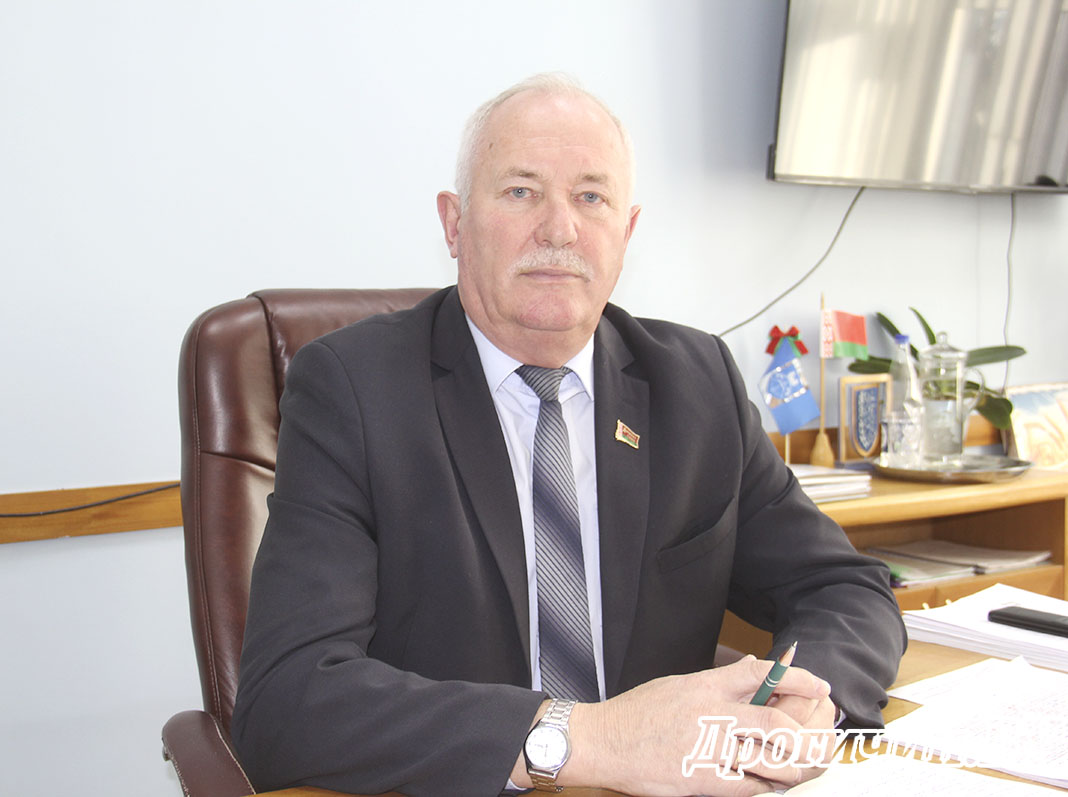
Title: Sergei Glinsky: "We need to look several steps ahead..."
By Sergei Glinsky
– Sergei Sergeevich, agricultural workers traditionally celebrate their professional holiday on the third Sunday of November, when all crops have been harvested from the fields, and it’s probably safe to discuss the results of the livestock industry’s work over the past year. How are the economic indicators in the district’s agricultural sector developing?
– Agriculture continues to develop dynamically, although some indicators this year are worse than last year. This primarily concerns crop production, where the growth rate of gross output over nine months was 92 percent compared to the same period last year. However, 2025 went down in the history of the Drohichin district as the most bountiful year for most agricultural crops, and we understand very well that achieving such high results is difficult. Even with strict adherence to technology, one cannot ignore weather conditions, and last year they were more favorable for farmers than ever before.
Overall, in the district’s agricultural sector, the growth rate of gross output over nine months was 101.2 percent, and in livestock farming – 106.8 percent. A total of 282 million 633 thousand rubles worth of gross output was produced, or 3 million 361 thousand rubles more than in the same period in 2025. The revenue growth rate was 106.9 percent. Almost all agricultural enterprises in the district increased their revenue compared to the corresponding period last year. However, at the same time, the cost of production increased by 14.8 percent. According to operational data, this year the profitability of sales, profit from sales, and net profit are lower in the district as a whole than last year. There are no unprofitable agricultural enterprises in the Drohichin region; all operate at a profit.
The average wage of rural workers was 2,776 rubles, which is 116 percent more than last year. The leaders in this indicator are SPK "Osovetsky", OAO "Alekseevich-Agro" and "Agro-Detkovichi". However, in OAO "Penyakovo" and "Radostovsky", the average wage is below two thousand rubles. This is understandable, as wages are not a social payment; they depend on the results of the enterprise’s work.
- Tell us more about how things were in crop production. """
""" Compared to last year, the district’s total grain production has decreased, though the results can’t be considered poor. It’s worth noting that this year we achieved our third-best performance in terms of total grain and corn production over the past five to ten years. The undisputed leader is, of course, 2025. In second place is 2024, when, including corn, we produced 109,892 tons of grain. This year, the district’s farmers harvested 108,558 tons of grain.
We fully implemented the technology, applied more fertilizers, and purchased around 20% of high-quality grain crop seeds. Our goal was to either surpass or at least match last year’s results. But, unfortunately, as I mentioned, weather conditions made their impact. The main reason for the crop shortfall was a lack of moisture. I’m not in the habit of making excuses by blaming the weather. We conducted a detailed analysis to identify where we fell short. Early spring crops were sown on March 11 and harvested by March 28, so the sowing season went smoothly. However, moisture from melting snow disappeared from the fields, and rains arrived when the grain was already ripe. In May, 31.9 millimeters of precipitation fell, or 51% of the monthly norm, and in June, it was just 15% of the norm. As a result, no grain crop—neither spring nor winter—exceeded last year’s yield levels.
Corn yield for grain production was also lower than last year. The total corn grain harvest was 26,000 tons, compared to 34,000 tons last year. Corn was sown on schedule, but by autumn, it became clear that part of the area where the crop was grown for grain needs to be converted to feed production to ensure sufficient corn silage reserves.
Winter rapeseed, however, performed well this season. On average, 32.4 centners of oilseeds were obtained per hectare, resulting in a total harvest of this highly profitable crop of 15,221 tons, which is 2,007 tons more than last year. """
Unfortunately, sugar beet crops failed to deliver good results, with the worst performance in five years. Last year, 94,000 tons of sugar beets were harvested, but this year the figure dropped to 48,000 tons. Many fields had to be replanted due to strong winds that damaged crops already suffering from drought. Currently, the average sugar beet yield in the region is 321 centners per hectare, which is 203 centners less than last year. The highest yield was achieved by OAO Lipnitsky, with 359 centners per hectare. OAO Stolichny Prospekt, a company specializing in sugar beet cultivation, grew sweet roots on 720 hectares in our region, with an average yield of 313 centners per hectare so far. However, since some of the harvest is still in piles in the fields, it’s too early to determine the final yield. There’s hope that it will reach 400 centners per hectare.
- Sergey Sergeevich, was it possible to fulfill the state’s agricultural product sales quota in this situation?
– I’m proud to say that Drohichin district has met all its state obligations regarding grain, leguminous crops, and rapeseed. Agricultural enterprises’ agronomists did an excellent job with brewing barley, which allowed us to successfully fulfill the state order despite an increase in demand. We delivered the full quota of buckwheat grain under the state order. This year, our millet crops—high-quality and abundant—helped Berezovsky, Ivatsevichsky, and Pinsky districts meet their state orders. Millet proved to be more resilient to drought conditions. We will also fulfill the state order for sugar beets.
Before the industry.