Menu
""" Pellets have been produced in the Osipovichi district for five years. """
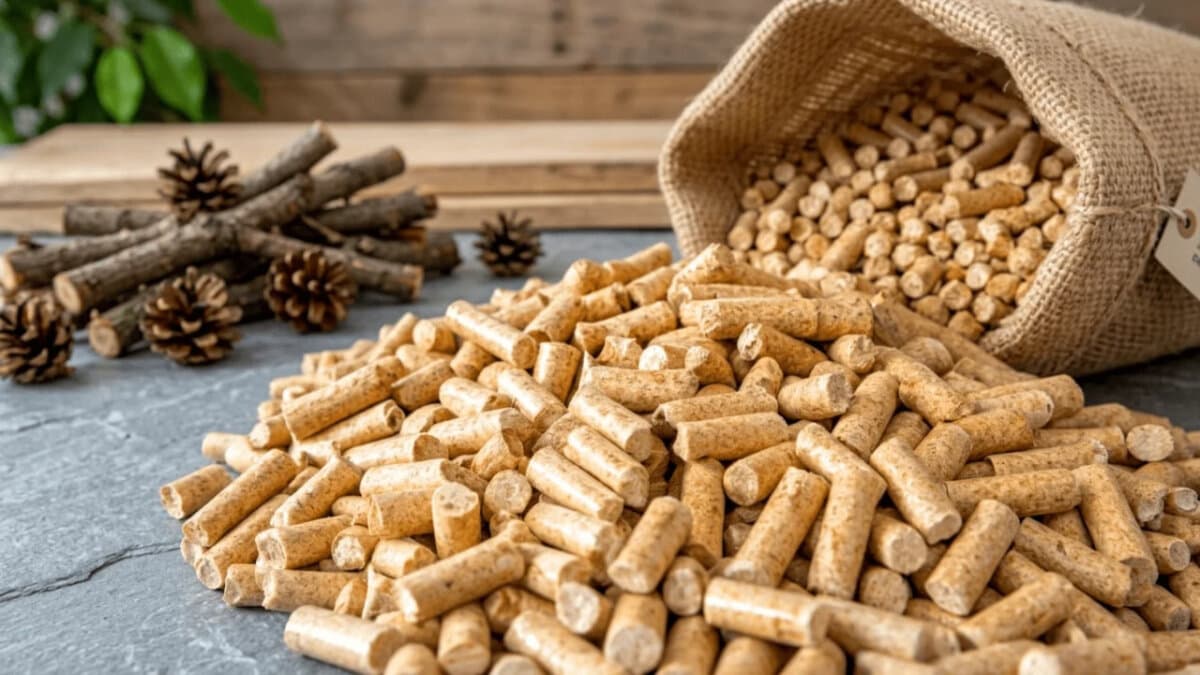
The search for alternative fuels has always been a pressing issue for society. Fluctuating prices of traditional energy resources and our dependence on their supply make economies vulnerable. Equally important are concerns about the environment and the need to use available resources efficiently. Recently, users have been paying more attention to pellets – a compact biofuel that helps convert wood resources into useful energy. And importantly, this approach is already being implemented.
Over the first nine months of 2026, the country’s forestry enterprises sold 6,200 tons of fuel pellets to the population, compared to just 1,800 tons during the same period last year.
The Osipovichi Experimental Forestry Enterprise, which has been operating in the district since August 2021, also contributes to the amount of fuel pellets sold and produced.
Today, 13 people work here in four shifts. The production facility is equipped with modern Lithuanian equipment that allows for the production of at least 3 tons of fuel pellets per hour.
“In our workshop, pellets are made from coniferous wood processing waste: sawdust and substandard chips. The raw materials are mainly supplied from the Lipen Forestry Processing Plant. It turns out that what used to be left unused now has practical application,” says Sergei Starovoytov, head of the fuel pellet production workshop. “In addition, pellets have a number of important advantages. Thanks to their dense shape, they are easy to store, transport and dose. The granules produce almost no dust and debris, which makes it easier to use and maintain order in the boiler room.”
At the enterprise, they are packaged in one-tonne bags, and we are also planning to launch a packaging line for bags of 15 kilograms.
Among the advantages of pellets is their high calorific value: almost twice that of firewood. At the same time, the granules are denser and drier, so they produce more heat per unit of volume. Another advantage is the complete automation of heating, as pellet boilers can operate without human involvement for up to several days. And because of low carbon dioxide emissions, minimal ash content and production from existing waste, pellets are called the most environmentally friendly type of fuel.
Today, the pellet workshop of the Osipovichi Forestry Enterprise sells its products in the district and the region.
The main consumers are housing and communal services enterprises, forestry departments, and individuals. """
""" The latter purchase 3–4 tons of pellets per month. Incidentally, this amount is roughly equivalent to what an average family needs for an entire heating season. You can buy either the full required quantity at once or in smaller portions.
Today, you can purchase fuel pellets from all forestry enterprises across the country, as well as from the branded retail outlets of the "Forest Cottage" network. The price depends on whether the buyer has a fuel booklet, transportation costs, and the type of packaging chosen. The price is fixed for both individuals and institutions, including businesses, housing services, and the Ministry of Energy. It may vary based on the distance to the consumer and changes throughout the year in accordance with legal regulations. By the way, social media and messaging apps often claim that "pellets from private sellers are better." However, the Ministry of Forestry asserts that this is a myth, as almost all wood pellets currently sold in the country are produced by Belarusian forestry enterprises.
Of course, pellets are not a universal solution to all fuel needs. Their effectiveness depends on the quality of the pellets, the equipment used, and the conditions of application. However, pellet production helps conserve resources: wood lasts longer, and consumers get convenient fuel. This is one of the main goals of modern forestry: to use resources carefully and comprehensively, so that the value of wood is revealed at different stages. """