Menu
""" In the Mogilev region, over 160,000 hectares of fallow land have been cultivated out of a planned total of 206,000 hectares. """
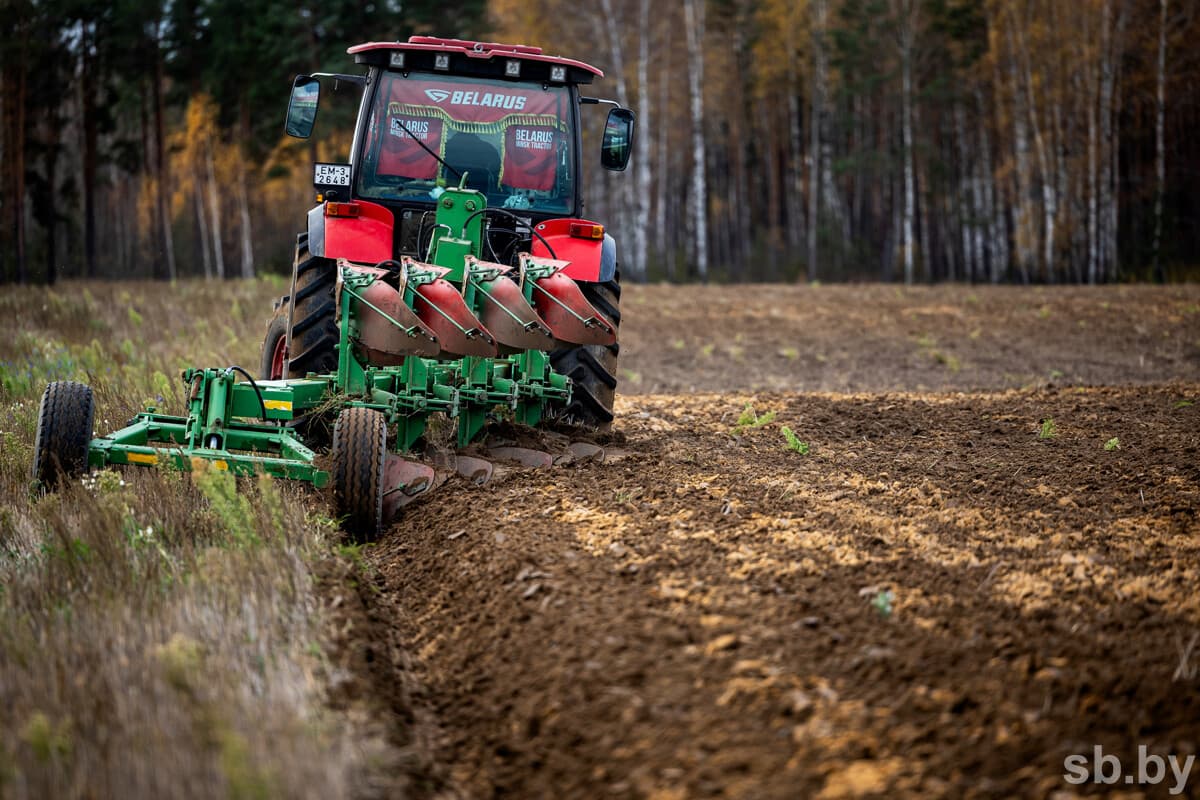
The Shklovsky and Belonichsky districts have already completed this work. The harvesting of corn and sugar beets is nearing completion, but the final stage of harvesting isn’t a time for rest—it’s just a shift in focus. While combines are finishing up the last hectares, farms are already laying the groundwork for next year’s harvest: the priority now is removing organic waste and preparing machinery for spring.
Meteorologists predict the first night frosts this weekend, but the engines are still humming in the fields. Experienced mechanic Ivan Gresko is wrapping up the season by plowing fallow land at the Voshod agricultural complex. The cabin of his tractor is warm, but outside lie the final hectares of autumn plowing, which will determine the future harvest. He worked over the weekend too. He says the key is to act quickly before frost sets in:
“When you turn over the soil layer on time, it becomes loose over winter, and weeds die. If you don’t plow in the fall, all the moisture will run off into the ravines in the spring—so don’t expect a harvest. Fallow land feeds the spring when every minute counts.”
Ivan Ivanovich is a jack-of-all-trades: he’s responsible for two tractors, a combine harvester, and a mower. His son Stanislav worked with him in tandem during the harvest. The young man studies at the Mogilev State Mechanical Engineering College and has been running to his father in the fields since childhood—his love of machinery is inherited.
Voshod has fully completed harvesting corn for silage and grain, and fallow plowing is now in its final stages—1,500 hectares were allocated for autumn plowing in total. They exceeded their feed preparation goals by a third compared to last year, creating a substantial surplus.
Voshod’s farmers were among the first in the district to sow and were quicker than their neighbors to complete silage preparation. Afterward, they sent their machinery to help other farms. Some machines were repurposed to transport organic waste to the fields.
According to chief engineer Vasily Zadorozhny, these results were achieved primarily thanks to machinery upgrades supported by the state:
“In 2025 alone, our agricultural complex acquired two MTZ-82 tractors, a loader, a MAZ with trailer equipment, and a mower. Since the beginning of this year, the fleet has been expanded with a new combine harvester, a feed dispenser, a press baler, and a tank for liquid fertilizers. We’re expecting a MAZ soon. The timely execution of all tasks is also supported by the mechanical unit of the Dnieper Inter-District Agricultural Service. The secret to success is simple: competent logistics, high motivation among mechanics, and a focus on results.” """
""" The Voskhod agricultural complex boasts over 4,650 hectares of farmland, with its primary goal being to supply feed for livestock. The complex houses more than 2,740 head of cattle, and its signature brand is a pig-breeding facility that has been operational for 50 years. Earlier this year, the workforce celebrated an anniversary, marked by the installation of an art piece—a plump piglet—in the heart of the agro-town. Veteran workers recall that Voskhod was the first in the republic to achieve a weight gain of over 700 grams during fattening in 1997. The profits generated were reinvested in extensive housing construction, and today, the agro-town of Voskhod remains a comfortable place to live, with well-developed infrastructure.
Acting Director Ivan Antonenko highlights that, thanks to state support, a commitment to modernization, and a focus on human resources, the Voskhod agricultural complex has a clear growth strategy for the next five years. This year’s plans include the reconstruction of three barns, with state investments totaling one million rubles. Modernization of the pig-breeding complex began in 2021, with upgrades to sewage, feeding, and heating systems. Several rooms are renovated annually, and efforts are underway to improve the breeding herd. At the start of the year, the herd size was 11,000, now it’s 16,000, and by year-end, it’s expected to reach 18,000. A new phase of reconstruction will enable the complex to reach 20,000 head.
Ivan Antonenko notes that the impressive results in livestock breeding and large-scale construction projects are underpinned by precise economic planning. Every aspect of the farm’s business plan is crucial, with each stage—including autumn plowing—contributing to the overall success.
“The cornerstone of our agricultural complex’s development strategy is its people,” emphasizes the interlocutor. “Today, we attract workers from Mogilev and the neighboring Bykhov district, and we provide transportation for our employees via our own bus. We also address housing needs by offering dormitory accommodation and, upon request to the district executive committee, rental apartments for employees. Furthermore, next year we plan to construct a rental house in the agro-town specifically for young specialists. The income levels also allow us to look confidently to the future: wages for mechanics across various roles range from 4 to 6 thousand rubles. This systematic approach, which combines fair compensation, care for living conditions, and modern production methods, clearly demonstrates that working in agriculture is becoming truly prestigious today.” """