Menu
""" Alexander Lukashenko visited the Orsha flax mill. """
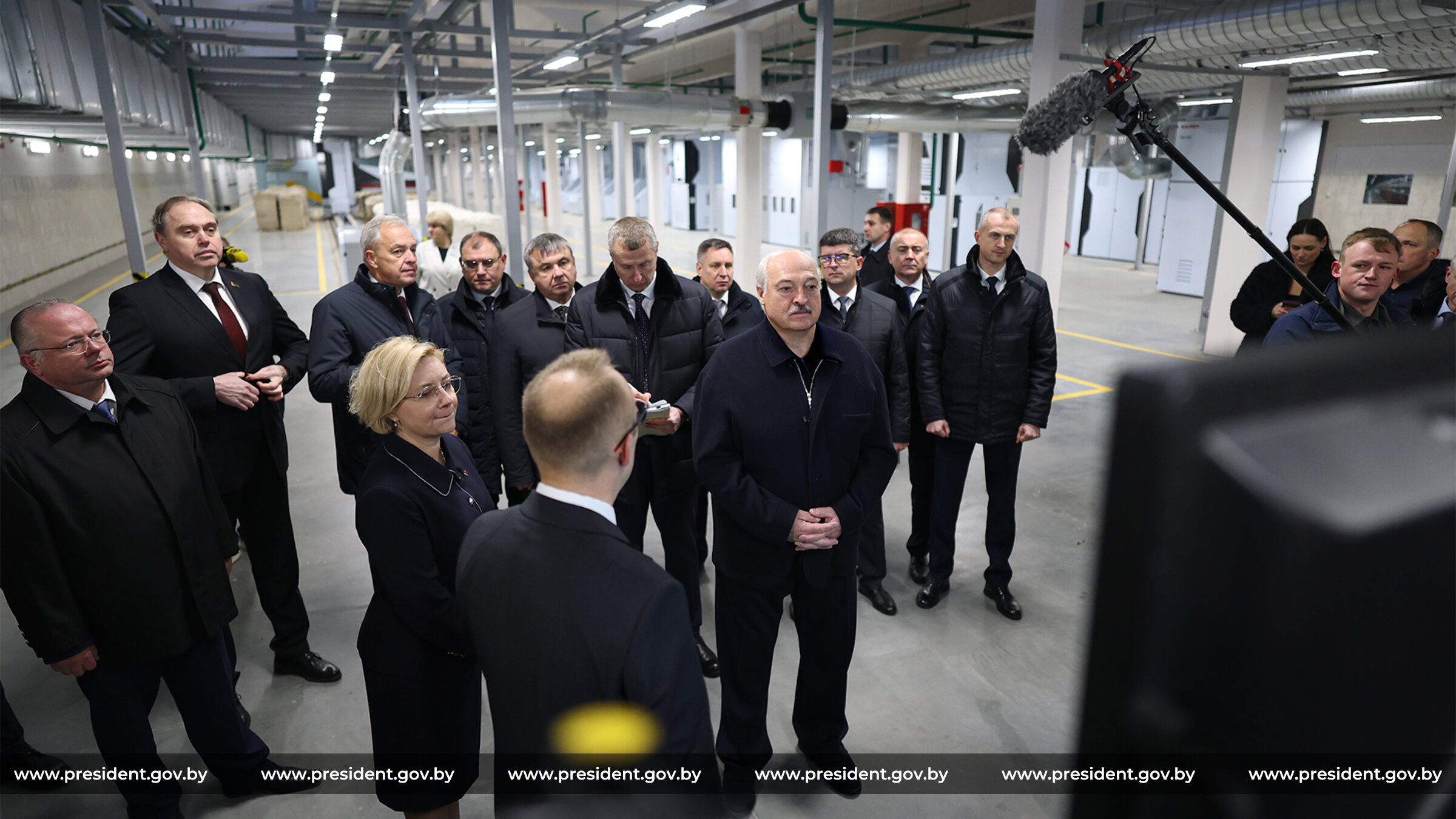
During a visit to the Orsha flax mill, Belarusian President Alexander Lukashenko learned about the company’s development prospects and participated in the launch of a new production line, according to the Belarusian leader’s press service.
A production line for high-count ring yarn made with cottonized flax fiber has been launched. The project will enable the production of new products.
The President was briefed on the development of the Orsha flax mill. The company has reached export volumes of $100 million, fulfilled the task of mastering deep processing of short flax fiber, pays a lot of attention to quality, and has been working only with its own flax fiber for several years.
“Our main task is to ensure that the raw materials are of good quality,” the Belarusian leader noted.
The Orsha flax mill is also planning further modernization in the coming years, including the introduction of the most modern dyeing technology, for example.
The plant’s equipment is mostly imported. Alexander Lukashenko recalled that he had previously instructed the industrial sector to learn how to make at least part of it. The head of state updated the relevant tasks, instructing General Director Oleg Buyanov to prepare a list of the most in-demand components and units that can be replaced by domestic production.
Alexander Lukashenko recalled that at one time it was his volitional decision to save the Orsha flax mill. “This is a very important enterprise for me,” he stressed.
The President set a goal for 100% of short flax fiber to be processed by 2030. To implement this task, the possibility of providing the enterprise with an additional loan to increase capacity is being discussed.
Currently, along with Belarus, the largest flax producers in Europe are France and Belgium. Belarus, on the other hand, has the entire chain—from cultivation in the field to the production of high-quality finished products. “With this approach, we will soon be the only ones left in the West,” the Belarusian leader noted.
“You know my approach. You don’t need to break anything. If we have something, we need to improve it. Without breaking or destroying anything,” Alexander Lukashenko told the plant’s workers during the launch of the new line.
He also stressed that any project should be implemented in the shortest possible time. """
""" During a visit to the Orsha flax mill, Alexander Lukashenko was shown an exhibition of products from the Bellegprom conglomerate. These included not only everyday clothing and home textiles, but also items for security forces, such as combat and uniform clothing, equipment, personal protective gear, and special clothing.
In recent years, domestic manufacturers have made significant progress in many areas, achieving substantial success in import substitution and creating their own unique products.
Alexander Lukashenko instructed officials to take advantage of this progress and supply more of the in-demand products to the domestic market, rather than purchasing abroad what can now be produced in Belarus.
The present and future of Belarus’s flax industry were the topics of a meeting held at the Orsha flax mill.
“For Belarus, flax is not only a strategic but also a political crop. Look at our country’s emblem. It’s an important part of our cultural and historical heritage, one of our symbols, and a significant segment of our economy. You could say it’s our gold, like cotton is for the Uzbeks,” said the Head of State, noting that the climate in Belarus is suitable for growing this crop.
“Today, Belarus is among the world’s top three leaders in the cultivation of northern silk, alongside France and Belgium. That’s what we’ve achieved—a modern ‘flax Normandy—Neman,’” the President said metaphorically. This Belarusian product is purchased in 43 countries worldwide.
“But the potential of our domestic industry is far from being exhausted,” Alexander Lukashenko said. “Flax is a unique plant that, with a competent approach, is almost waste-free. It’s used in the textile, food, chemical, construction, and military industries, as well as in medicine. Those who choose flax make a solid contribution to ecology and health—supporting both their own well-being and that of their family.” In this regard, the Head of State encouraged everyone to make more extensive use of flax fabrics and products in daily life.
The President noted that since gaining independence, the Belarusian state has paid increased attention to the flax-growing industry. After the collapse of the USSR, many collective and state farms abandoned flax cultivation because it was very hard work and yields were modest. “If the state hadn’t helped the villagers at that time, there would be no flax in Belarus,” he added. """
""" Alexander Lukashenko recalled visiting the Orsha flax mill at the start of his presidency, noting that it was then an enterprise of a completely different level. Over the years, the state has invested huge amounts of money in the flax industry, including in harvesting machinery, modernization of flax mills, development of cultivation technologies, and scientific support.
“The important thing for me is that we are now discussing not the survival of the flax industry, but its development across the entire value creation chain,” the Belarusian leader stressed.
Speaking at a meeting on the development of the flax industry, Alexander Lukashenko said it was necessary to reconfigure state support mechanisms.
The head of state stressed that the discussion was not about the survival of the flax industry, but about its development across the entire value creation chain.
The President noted that flax can be grown in all regions of the country, as evidenced by last year’s results. For example, the average number of long fibers was 9.7, and short fibers was 2.8. “But with adherence to technological discipline, it can be better. After all, that’s how the leaders achieve it,” the President said. For example, at JSC “Gorkilen”, the average number of long fibers was 10.6, and short fibers was 3.7. Good expertise has been developed at the Pruzhany and Korelichi flax mills.
“With such numbers, the economy is also good. But unfortunately, this is not the case everywhere. There are 19 flax mills in the country. And r """