Menu
""" A farm nail. How one stubborn farmer has been holding up construction of a giant airport for years """
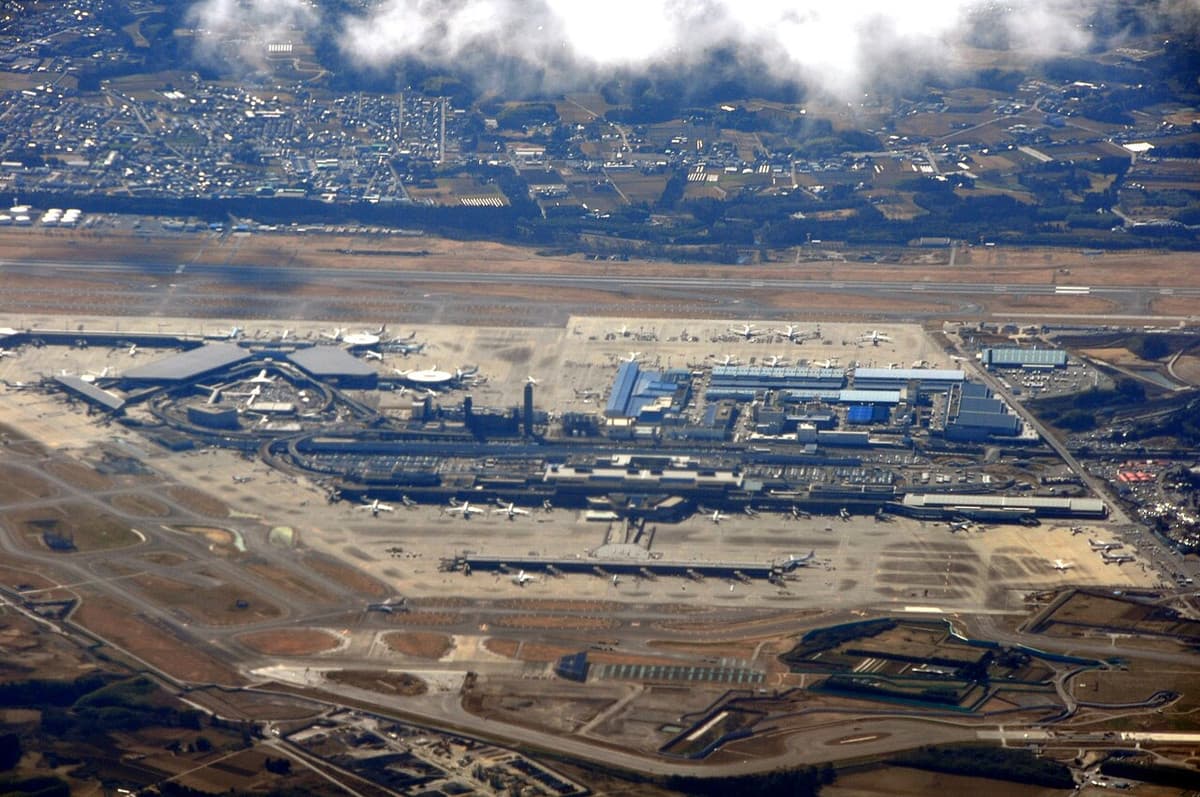
Satellite images of Tokyo’s Narita Airport, Japan’s main international gateway, reveal a peculiar layout. The taxiway that planes use to access the terminal after landing suddenly bypasses a fenced-off patch of land. Radishes, peas, and onions still grow there, despite hundreds of planes from around the world taking off and landing just a hundred meters away every day. Why has a massive transport hub serving over forty million passengers annually been so delicately adapted to coexist with a regular vegetable garden? The reason is a conflict that began exactly 60 years ago, ultimately leading to clashes with police, mass riots, and even human casualties. Today, the heated phase of the confrontation is over, but the land war is not finished. Despite losing lawsuits, 76-year-old farmer Takao Sito still cultivates his plots while the airport operator prepares for another round of forced acquisition of other people’s land. In this dispute, two truths have collided: the state and the peasant. The scar of their struggle is still visible from the window.
A new airport
By the early 1960s, Japanese officials calculated that the old main Tokyo airport, Haneda, would no longer be able to handle the influx of passengers by the end of the decade. In 1962, the government decided to build a new international hub, but problems with selecting a suitable site began immediately. The Tokyo Bay coast was rejected due to overly cramped airspace, and the sky west of the capital was densely occupied by American and Japanese military bases. In late 1965, ministers preliminarily selected the rural area of Tomisato in Chiba Prefecture, but local farmers, supported by left-wing parties, stirred up such a scandal in the media that construction came to a standstill before it even began.
The authorities decided to outsmart the protesters and, in June 1966, unexpectedly moved the project to the neighboring area of Sanrizuka, just five kilometers from Tomisato.
Its residents learned that their fields and homes would be bulldozed from the morning newspapers. On July , Prime Minister Eisaku Sato’s cabinet officially approved the plan for a large airport with five runways, and just a month later, a state corporation was established to build it. """
""" The sudden change of location seemed odd. Historians have yet to find any archival documents explaining this move, but officials’ motives were easy to understand. Unlike Tomisato, where every hundred acres would have had to be bought from different owners, more than half of the required land in Sanridzuka already belonged to the prefecture and the imperial court. Tokyo decided that the remaining private plots could be taken over quickly and without unnecessary fuss. As future events showed, this was the government’s biggest mistake. The peasants in Sanridzuka turned out to be far more vicious and organized than their neighbors.
The conquered land
Sanridzuka could hardly be called a remote province. Before World War II, the imperial pasture of Simosa, covering about 1,400 hectares, operated there. After 1945, the authorities allocated about 900 hectares for settlement. The land was taken over by former soldiers, repatriates from former colonies, and fire victims from bombed cities. People manually uprooted bamboo and turned wasteland into farmland, often plowing the plot first and then registering it. By the mid-1960s, hard work finally began to feed families, and it was at this moment that five newly established settlements were located on the site of the future airport.
That is why monetary compensation for some local residents did not work as an argument. The settlers valued their fields at 20 years of hard work spent clearing wasteland, and the promised payments could not replace that effort. Many people refused to move to a new place and start over, in a samurai-like manner.
At the same time, a united front did not form among local residents.
The authorities quickly switched to a carrot-and-stick tactic, and some peasants wavered. Within a few months, the municipal councils of Narita and Shibayama withdrew their resolutions against the construction. Proponents of the deal united in several organizations to extract the maximum price and best relocation conditions from the state. The strategy worked. By spring 1968, the Narita construction corporation had bought up almost 90% of private plots. Later, tax revenues and state subsidies turned the district into an “airport town.” It became harder for dissatisfied people to protest, as some residents of Sanridzuka had found jobs in the construction of the airport and became its defenders.


From petitions to barricades """
""" The "refuseniks" formed their own union to oppose the construction of an airport. The union, established in the summer of 1966, was led by Issaku Tomura, a devout Christian and agricultural machinery trader. The movement was organized around local communities, with separate groups for the elderly, women, young farmers, and even schoolchildren. Initially, the peasants acted within the law, submitting petitions, staging sit-ins, and dividing their land into tiny plots among hundreds of supporters, turning land acquisition into a bureaucratic nightmare. In 1968, elderly residents even sent a respectful petition to the emperor, asking him to postpone the construction.
The document was written in the language of loyal subjects and bore little resemblance to a revolutionary manifesto.
The turning point came in October 1967, when authorities brought in around two thousand police special forces soldiers to mark the boundaries of the future airfield. The peaceful protest ended. Student left-wing radical groups of the "new left" came to the peasants' aid en masse, bringing with them helmets, wooden poles, Molotov cocktails, and extensive experience in street fighting. The traditional Communist Party of Japan quickly distanced itself from such allies, and the farmers' main support became street radicals.
By the spring of 1968, the confrontation escalated into full-scale battles.
During the February clashes at Narita City Hall, the union leader Tomura himself was seriously injured, and dozens of protesters and police officers ended up in hospitals. Meanwhile, the peasants managed to fight on two fronts: while holding their ground at the barricades, the union also ran in local elections and immediately won nine out of twenty seats in the local municipal assembly.


The bloody year of 1971 """
""" In late 1969, authorities invoked an administrative measure and initiated a process of compulsory land acquisition for public purposes. To avoid lengthy court battles, amendments were made to the law in 1970, allowing buildings to be demolished even before final compensation was paid. The deadline for voluntary evacuation passed in January 1971, and by February, nearly three thousand police officers equipped with bulldozers had been deployed to Narita. By then, farmers and students had transformed the disputed areas into fortified strongholds. Activists dug deep bunker-like pits, erected wooden forts, and surrounded the perimeter with barbed wire. The assault lasted for two weeks. After clearing the first area, the transport minister arrogantly declared that the peasants would now realize the futility of their struggle.
The opposite effect was achieved. The protesters only grew more determined.
The second wave of clearing in September 1971 ended in tragedy. At the Tohoko intersection, a group of masked radicals armed with bamboo spears and incendiary bombs attacked a police unit, killing three officers. The investigation was never able to reconstruct the exact sequence of events. The trial ultimately spanned 15 years, and none of the 55 defendants received actual prison sentences. Three were acquitted, while the rest received suspended sentences.
Unfortunately, the victims of the "Tohoko intersection incident" were not the last. Over the decades of conflict, 13 people were killed in clashes, including five police officers.

For the common good
The authorities' persistence was also understandable. Japan's economy was experiencing rapid growth, and without a new airport in Tokyo, the country risked losing its status as a major Asian aviation hub. Under Japan's constitution, private property can be expropriated for the public good in exchange for fair compensation, and a relevant law explicitly allowed for the seizure of land for strategic construction projects. From the officials' perspective, the interests of a handful of farmers could not possibly outweigh the needs of the entire country and tens of millions of passengers. Especially since, at least on paper, the procedure appeared legally sound, involving hearings, independent assessments, and culminating in generous payments and the creation of new jobs for locals.
However, there were significant flaws in this process. """
""" Grand ambitions had to be scaled back along the way. As early as the late 1960s, the project was reduced from five runways to one 4-kilometer runway, with a second one built only 30 years later. But even the almost completed airport stood idle in the mid-1970s—the airliners had nowhere to refuel. Residents of neighboring cities rebelled against the construction of a fuel pipeline, and local authorities blocked the transport of kerosene in railway tankers. As a result, the airport was not opened until May 1978, seven years later than planned, and even then there was a new scandal: a few months before the launch, radicals broke into the territory and destroyed the control tower.

Three generations of renting
By the early 1990s, the street war around the airport had subsided, and the main arena for confrontation became the courtrooms. In this new era, farmer Takao Sito found himself at the center of the conflict. His farm is located in the village of Tendjinmne, where the protest field headquarters once operated. The land had been rented and cultivated by three generations of the family for almost a hundred years: first the grandfather, then the father, who went to the barricades and switched to organic farming, and then Takao himself. Today he grows pesticide-free organic vegetables and sends them to four hundred regular customers in the Tokyo area. The farmer refuses to move for a very practical reason. His family has been building up fertile soil for organic farming for decades, so it is impossible to simply move the beds to another vacant lot.
The legal conflict surrounding this garden arose from a series of bureaucratic deadlocks.
The state corporation that built the airport secretly bought Sito's plot from the previous owner back in 1988, but did not inform the tenant himself about the transaction until 15 years later. By 2003, it was no longer possible to forcibly evict the farmer under the old rules. The twenty-year validity period of the 1969 project permit had long since expired, and the specialized land expropriation commission in Chiba Prefecture had resigned en masse in 1988 after a brutal attack on its chairman by left-wing radicals.
At that point, the airport management, which changed its name to a joint-stock company in 2004, decided to bypass the rules. """
It secured permission from the governor to terminate the lease agreement under the standard agricultural land law. Takao viewed this as a disguised expropriation, but the transport operator insisted the deal was legal and had been approved by the prefectural authorities. In 2013, the court ruled in favor of the airport, deeming the proposed compensation of 180 million yen (approximately $1.8 million) more than generous. The judges calculated that this amount would be sufficient for a medium-sized farm in the prefecture to operate for 150 years. "It's not about the money," Sito countered.


Tunnels beneath concrete
To understand the appearance of the "nail farm," one should view Narita from above. The runway should be a perfectly straight concrete strip, while the taxiway functions like a regular street where planes roll from the runway to the terminal or vice versa. Takao's plot adjoins a taxiway leading to the second runway, forcing builders to curve it.
The airport itself also spent decades assembling the second runway piece by piece.
By the time of the 2002 World Cup, it was opened in a shortened form, measuring 2,180 meters instead of the planned 2.5 kilometers, as the land on the southern side could not be acquired. The runway had to be extended in the opposite direction, to the north. These detours doubled the construction time for the company, nearly doubling the budget. Costs escalated to $300 million.
""" The Sito farm now resembles a green oasis surrounded by grey concrete slabs, with some of its fields only accessible via underground tunnels beneath the runway. The farmer has long grown accustomed to the constant hum of engines. Regular air and groundwater tests show no sustained exceedances of emissions, making it feasible to grow organic vegetables near airplanes. Takao speaks of the main domestic inconvenience with a slight smile. On his way to his own plots, he is frequently stopped by airport security, who demand to see his documents, even though the guards have known him for years.


What happens next?
After the Supreme Court finally upheld the eviction order against Sito and rejected all his appeals, the conflict returned from the courtroom to the ground. The dispute over the leased plots has dragged on for nearly 20 years, but a resolution was finally reached in February 2023. Under the cover of hundreds of police officers, bailiffs entered the farm and brought in heavy machinery. The farm's defenders barricaded themselves in a wooden watchtower, and clashes with police continued until dawn. However, by morning, excavators had demolished the tower, the propaganda boards, and the farm buildings near the second runway. The head of the airport operator then expressed relief, stating that it would now be much easier for pilots to land.
Yet, the stubborn farmer from Narita has not been completely driven out.
In March 2025, a court ordered Takao to be evicted from two additional plots purchased by the company, totaling about 0.6 hectares. However, the farmer immediately appealed the decision, and the process has once again stalled in appeals. The key point is that the farmer still owns the plots outright, and they cannot be confiscated from him. """