Menu
""" A "Big Talk" with the President on flax issues. Lukashenko outlined problems and set tasks. """
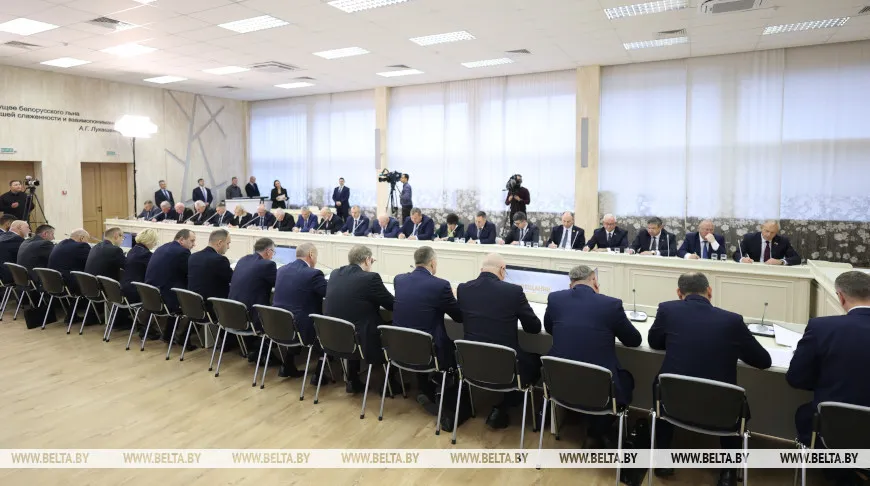
The current state and future of Belarus’s flax industry were discussed at a meeting held at the Orsha flax mill, according to the Belarusian leader’s press service.
“For Belarus, flax is not only a strategic but also a political crop. Look at our country’s coat of arms. It’s an important part of our cultural and historical heritage, one of our symbols, and a significant part of our economy. It’s safe to say that it’s our gold, alongside timber and potassium,” said the head of state. He noted that the climate in Belarus is suitable for growing this crop.
“Today, Belarus is among the world’s top three leaders in the cultivation of northern silk, alongside France and Belgium. That’s what we’ve achieved with our modern ‘flax Normandy-Neman,’” the President said metaphorically. This Belarusian product is purchased in 43 countries worldwide.
“But the potential of our domestic industry is far from being fully realized,” Alexander Lukashenko believes. “Flax is a unique plant that, with proper management, is almost waste-free. It’s used in the textile, food, chemical, construction, and military industries, as well as in medicine. Those who choose flax make a significant contribution to ecology and health—both their own and their family’s.”
At a meeting on the development of the flax industry, Alexander Lukashenko emphasized the need to reconfigure state support mechanisms.
The head of state stressed that the discussion is not about the survival of the flax industry, but about its development across the entire value creation chain.
The President noted that flax is grown in all regions of the country, as evidenced by last year’s results. The average number of long fibers is 9.7, and short fibers is 2.8. “But with proper technological discipline, it can be better. After all, that’s how the leaders achieve it,” the President observed. For example, at JSC “Gorkilen,” the average number of long fibers is 10.6, and short fibers is 3.7. Good expertise has been developed at the Pruzhany and Korelichi flax mills.
“With such numbers, the economy is also doing well. But, unfortunately, not everywhere. There are 19 flax mills in the country, and their performance varies significantly,” Alexander Lukashenko noted.
For example, two mills in the Brest region earned a net profit of 18.3 million rubles in January–September 2026, while two mills in the Gomel region earned 2.4 million rubles. However, six mills in the Vitebsk region incurred a net loss of 1.2 million rubles. """
Fragment 2/2 of the article to translate:
""" To move forward, all flax mills are undergoing regular planned modernization, including the flagship Orsha flax plant, where a new production line has been launched to process more short flax fibers.
"We have no helicopter money. Everything we allocate is a loan with a specific timeframe, during which you must implement the technology and achieve the economic indicators outlined in your business plans," the head of state emphasized. "You go to banks and the Ministry of Finance with these plans, defend them, and receive funding. Please do what you and your teams have calculated. The state has something to do and something to finance."
The President noted that the government is currently developing a new system to support agriculture, which will also impact flax farming.
"We must, without offending the peasants, reconfigure assistance mechanisms to ensure we obtain the raw materials we need and the demanded products—yarn, fabrics, and finished linen goods. We will consider the state support system comprehensively: subsidies, state orders, cost reduction, and a pilot project for flax fiber exports," said Alexander Lukashenko.
- subsidies
- state orders
- cost reduction
- pilot project for flax fiber exports """