Menu
""" "The foundation of life and development": the ideologist of Mogilev GPhLO visited Cherikov forest enterprise during information day. """
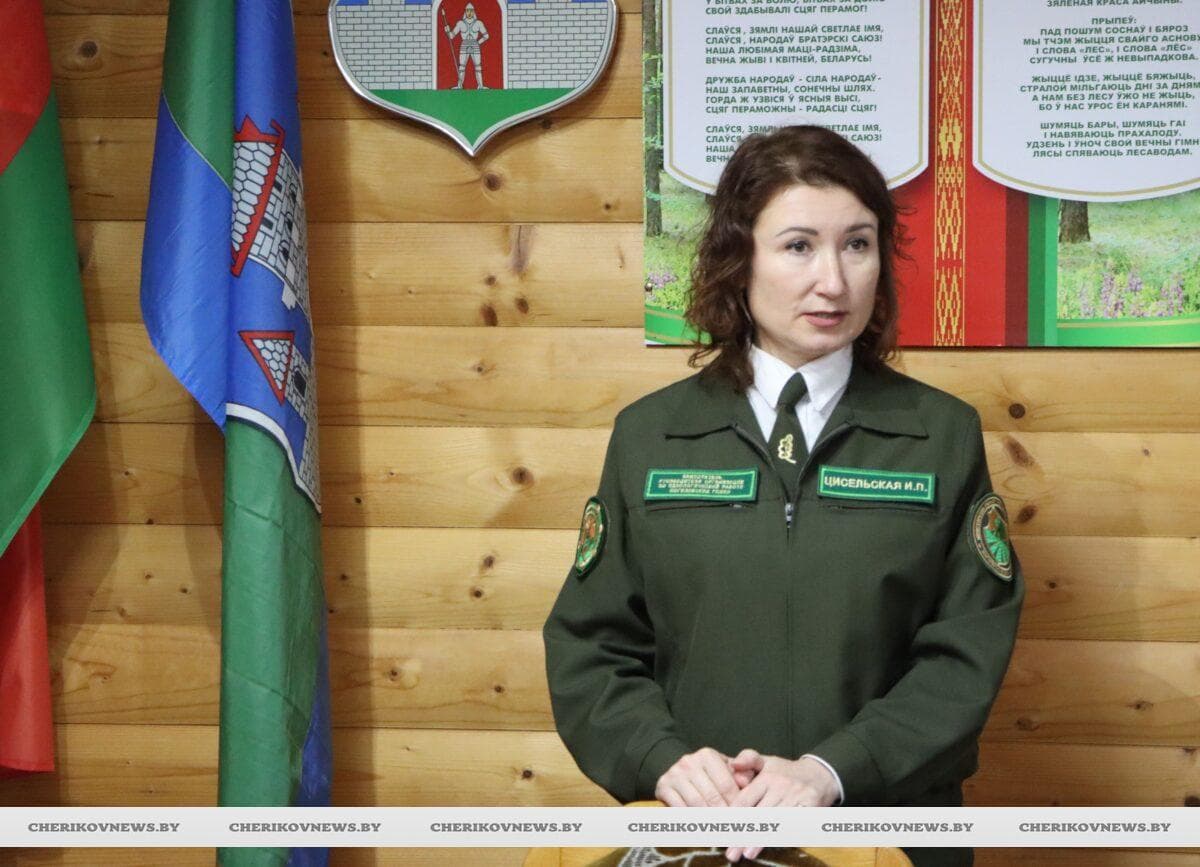
Autumn, and especially November, is traditionally the time when people take stock of the agricultural year, assessing its success and productivity. It’s no surprise, then, that food security in the country became a key topic of discussion at the latest unified information day, held on November 19 across the country’s labor collectives, organizations, institutions, and enterprises.
The discussion on “Belarusian Bread – 2026: The Country’s Food Security” also took place at the Cherikov Forestry Enterprise. The staff of this forestry institution were visited by a representative of the regional information and propaganda group—Irina Tsisel’skaia, deputy head of the Mogilev State Production Forestry Enterprise responsible for ideological work.
Irina Petrovna immediately suggested that the meeting be held in a dialogue format, encouraging an exchange of opinions. She began the discussion with a key question: Why is food security so important for any country?
Responses from the audience all conveyed the same idea: “Because the need for food is a fundamental human requirement. When this need is met, people can lead active, productive lives.”
“Yes, you’re right,” continued Irina Tsisel’skaia. “Food security is the foundation of any nation’s independence and sustainable development. That’s why one of the key priorities of Belarus’s socio-economic strategy remains the development of rural areas and agricultural production. The quality of nutrition is essential for the well-being of every Belarusian. At the same time, agriculture is a multifunctional sector that drives growth in related fields, including the food industry, trade, public catering, engineering, and science.”
Irina Petrovna shared some figures: One person working in agriculture supports 7 to 10 jobs in urban areas, spanning sectors like the food industry, trade, public catering, engineering, and science.
“The Belarusian model of food security is based on a simple yet wise principle: to provide for ourselves through our own production,” she said. “Because production volumes for many items have significantly exceeded domestic needs, Belarus has become one of the world’s leading food exporters.” """
Fragment 2/2 of the article to translate:
""" Irina Tsiselskaya provided a detailed account of Belarusians' access to domestically produced agricultural goods and food, the proportion of Belarusian products on store shelves, agricultural productivity over the past 30 years, and export potential. For each of these subtopics, the deputy head of the organization's ideological department at Mogilev GPKHO supported her statements with examples from the lives of Belarusians, making the meeting highly informative and accessible to all.
Irina Petrovna concluded her speech with a quote from Belarusian President Alexander Lukashenko, delivered during a working visit to the Minsk region on October 12, 2026: "Under no circumstances should you compromise on quality. Quality will always prevail. People want quality goods, especially food." The speaker emphasized that these words should be applied to every field and become a fundamental principle for each of us in our work.
Question from the audience
During the unified information day, employees of the Cherikov forestry department took advantage of Irina Tsiselskaya's invitation to share their concerns.
The discussion turned to transportation between our city and the capital, as well as between Cherikov and Gomel, an issue that affects most parents of students.
"We would really like to see the bus route from Cherikov to Minsk and back reinstated, because buying a ticket on a minibus on weekends in this direction is often impossible, and even more so before holidays. It could be a passing bus from Kostyukovichy or Khotimsk—it doesn't matter—as long as it exists. The same problem exists when it comes to getting to Gomel. The 'Krichev - Gomel' bus only offers five advance tickets to passengers from Cherikov. If you don't manage to book one, you never know whether your child will be able to go to school or not," said forest workers whose families have students, highlighting the issue.
Irina Tsiselskaya assured that she would include this issue in her report to the EDi and bring it to the attention of the relevant departments of the regional executive committee, after which she would provide feedback to the forestry department representatives who raised the problem. """