Menu
""" The Gomel chemical plant held a discussion on food security and the country's future. """
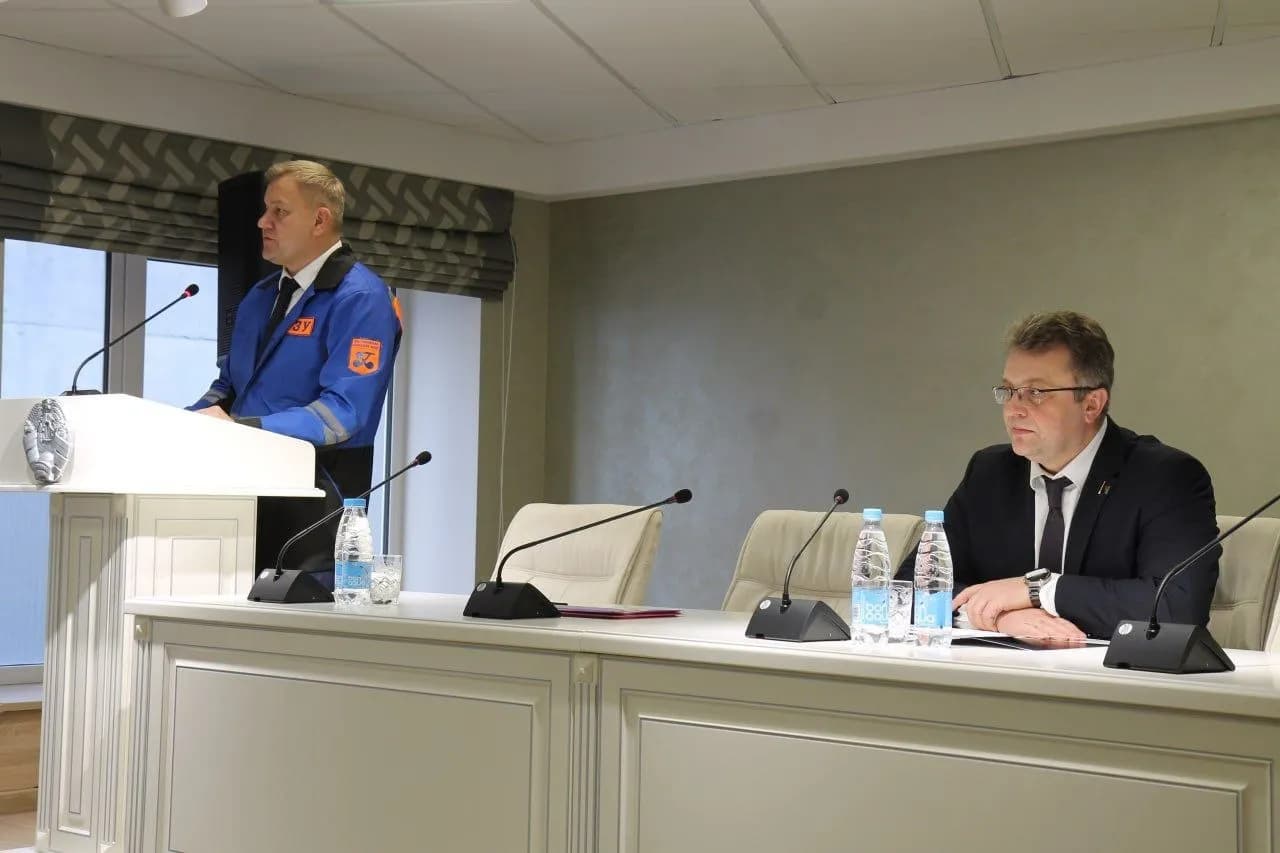
As part of the Unified Information Day, Belneftekhim Concern Chairman Ilya Ikan met with employees of Gomel Chemical Plant JSC. A key topic of the November discussion was "Belarusian Loaf 2026: The Country's Food Security."
Addressing the plant's workers, the concern's head presented compelling figures. According to the Eurasian Economic Commission, Belarus has achieved 95% self-sufficiency in agricultural products and food. This figure rises to around 300% for milk and dairy products, 140% for meat and meat products, and exceeds 101% for vegetables and potatoes. Over three decades, from 1995 to 2025, agricultural productivity has increased dramatically. Domestic crop varieties are widely used in fields, and a diverse range of Belarusian products, including specialized nutrition for young children, preschoolers, and school-age children, are available on shelves.
"Belarus consistently holds strong positions in the global market," emphasized Ilya Ikan. "Our country ranks among the top five in milk product supplies and among the top 15 in poultry meat, beef, and sausage exports. Our share in mutual trade of food products within the Eurasian Economic Union market exceeds 40% annually. Belarus supplies food to over 115 countries worldwide. The growth rate of food product and agricultural raw material exports in 2025 compared to 2020 was 176%. By the end of 2025, exports of food products and agricultural raw materials reached a record high of $10 billion, or 118% of the 2024 level. Foreign exchange earnings increased by $1.6 billion."
The concern's chairman also highlighted off-season reserves. Over 165,000 tons of the so-called "borsch collection" products have been allocated to stabilization funds for 2026–2027. The harvest exceeded last year's, the state order has been fulfilled, ensuring that retail chains and social institutions will have uninterrupted access to vegetables and potatoes throughout the winter-spring period.
Ilya Ikan noted that the Gomel Chemical Plant team—one of the city-forming enterprises of the city, region, and the entire petrochemical system—makes a significant contribution to the overall Belarusian loaf. Modern agriculture and high yields are unimaginable without the high-quality phosphorus and complex fertilizers produced in Gomel. """
""" The industry’s role extends far beyond supplying fertilizers and fuel. Ilya Ikan noted that the Belneftekhim conglomerate includes 11 agricultural enterprises, employing over 4,700 people. Between January and September 2026, these agricultural companies produced goods worth 446.7 million rubles at comparable prices, a 107.9% increase compared to the previous year. They harvested 143,700 tons of grain, with an average yield of 42.3 centners per hectare—4.7 higher than the national average.
“The President’s goals for enhancing food security cannot be achieved without high-quality fertilizers,” Ilya Ikan emphasized in a conversation with journalists. “This includes the Gomel Chemical Plant, Grodno Azot, and Belaruskaliy. The country’s total grain production, exceeding 11 million tons including rapeseed and corn, was made possible not only by agricultural enterprises but also by the workers at our petrochemical plants.”
The conglomerate’s head also highlighted that, despite external challenges, the industry’s companies are successfully meeting both qualitative and quantitative targets. They fully satisfy the growing domestic demand for fertilizers and continue to supply oil products to neighboring countries, including the Russian Federation. This foundation allows for confident planning for the upcoming year.
The second topic of the meeting—“The All-Belarusian People’s Assembly as a guarantor of stability and progressive development of the country”—was addressed by Dmitry Chernyakov, Director of OJSC Gomel Chemical Plant.
The company’s leader asked the team to reflect on the beginning of sovereign Belarus’s journey in the early 1990s. The country was experiencing a deep systemic crisis: production had fallen by 40%, agriculture had regressed two decades, factories were shutting down, and unemployment and crime were rising. The turning point was the first All-Belarusian People’s Assembly in 1996, which formulated a clear development strategy for years to come. Time has proven the wisdom of the chosen path toward a socially oriented economy: by the end of the first five-year plan (1996–2000), the country’s GDP grew by 35.7%, industrial production increased by 64.4%, and housing construction rose by 81.1%.
Dmitry Chernyakov recalled that after the 2022 constitutional reform, the All-Belarusian People’s Assembly became the highest representative body of people’s power. Its meetings are held at least once a year, with the next one scheduled for December 17–18. """
Fragment 3/3 of the article to translate:
""" Factory workers in the hall were curious about the specific topics that would be discussed at the upcoming people's meeting. In response, the plant director explained that the final agenda would be confirmed next week at a meeting of the VNS Presidium, but the key items were already known: delegates would hear the President's annual address to the Belarusian people and parliament, as well as the Prime Minister's report on the progress of the country's social and economic development programs.
The meeting at the Gomel chemical plant was held in an open dialogue format, allowing employees to receive comprehensive answers to all their pressing questions. """