Menu
Opinion on the matter. Why did Nvidia's shares collapse and where did its longtime leader disappear to?
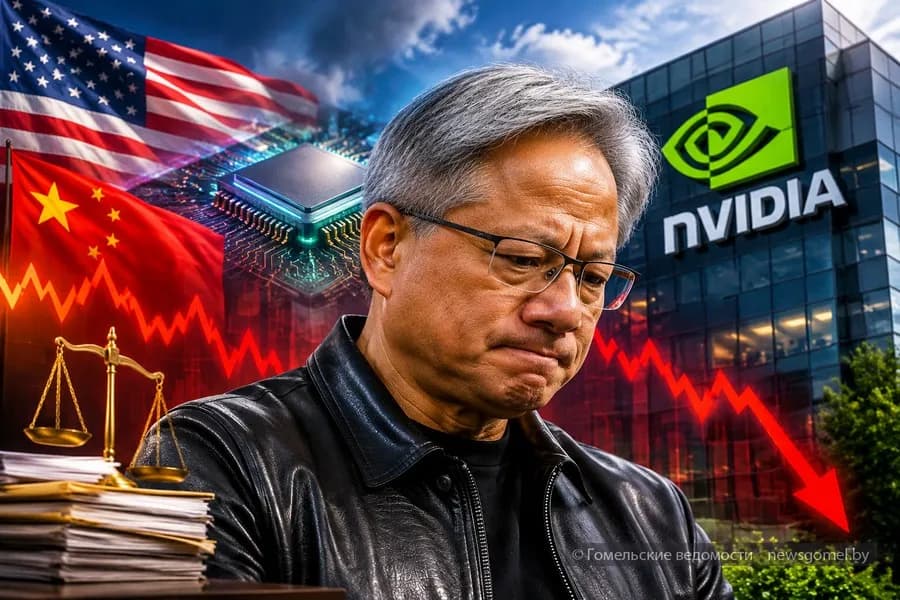
American Nvidia is experiencing one of the most serious crises in the company's history. Its founder and CEO, Jensen Huang, has left his post, stepped down from the board of directors, and the tech giant's shares have plummeted. Behind the seemingly sudden resignation lies a story that intertwines suspicions of Chinese espionage, controversy over the export of advanced microchips, investigations by American authorities, and a personal scandal surrounding the head of the corporation.
The beginning of this story dates back to 2025, when American authorities became interested in the Singaporean company Megaspeed, which was purchasing servers with Nvidia accelerators. Suspicions arose that the equipment could be diverted to China via third countries, circumventing US export restrictions. Particular attention was drawn to Alisa Huang, the head of Megaspeed, who had business contacts with Nvidia. According to the American intelligence version, she could be working for Chinese intelligence and gathering information about the company's plans and its leadership.
The Singaporean authorities confirmed the investigation into possible violations in the procurement and movement of servers, but emphasized that Alisa Huang was not suspected of espionage and no corresponding investigation was conducted against her. In February 2026, the investigation did not find sufficient evidence of her involvement in the alleged violations, and she was given a strict warning for providing inaccurate information to investigators. The investigation into Megaspeed continued.
The political aspect of the case proved to be no less notable. US President Donald Trump had been in contact with Huang, who advocated for expanding American supplies to the Chinese market. In December 2025, Trump announced the possibility of selling China H200 accelerators under certain conditions. In January 2026, the US administration formalized the licensing mechanism for such supplies, which was a change from the previous course, in which Washington sought to limit Beijing's access to the most powerful American technologies.
However, according to American media reports, intelligence information about Alisa Huang's possible connections to Beijing had been received by the administration before these decisions were made. In the spring of 2026, Secretary of State Marco Rubio, as reported, prepared a closed memo and warned Trump about the suspicions. Despite this, Huang eventually joined the president's trip to China. Trump himself later said that he had discussed the situation with the head of Nvidia and believed his words that he was unaware of the woman's alleged connection to intelligence.
A new wave of scandal began at the end of October 2026, when American publications released information about Huang's close relationship with Alisa Huang. In early November, the Nvidia board of directors announced an independent investigation, which was entrusted to the committee of independent directors with the assistance of external lawyers. The company stated that it did not yet have grounds to believe that its secrets or US national security had been compromised.
Then there were reports of another alleged connection of Huang's - with a high-ranking female employee who was subordinate to him at the company. Against the backdrop of new publications, the board of directors met on November 11 to discuss the future of the leader. Already the next day, it became known about Huang's resignation. Colette Kress, the financial director, was appointed as the temporary CEO, and Harvey Jones became the chairman of the board of directors. A permanent successor has yet to be chosen.
At the same time, it was revealed that the US Department of Justice is conducting several investigations. One directly concerns Nvidia and antitrust issues. Two more are related to Megaspeed and Supermicro, in particular with Alisa Huang's activities and possible circumvention of export restrictions. However, according to Semafor, there are currently no signs of intention to bring criminal charges against Nvidia or Huang.
The financial markets reacted instantly and painfully. By the time of the resignation, Nvidia's shares were already under pressure: from their October maximum, they had lost about a third of their value, and the market capitalization had decreased by more than a trillion dollars. Against this backdrop, the news of the founder's departure caused an additional decline: in the pre-trading session, the quotes fell by approximately 10-11%, and during the day, losses at times exceeded 14%. Investors are concerned not only with the change in leadership but also with the uncertainty surrounding the Chinese direction of the business, export restrictions, and the future of the entire artificial intelligence industry. Additional pressure is created by concerns about massive debt investments in data centers and possible slowing demand for computing power.
I would say that what is happening with Nvidia cannot be explained solely by the scandal surrounding Alice Huang and her alleged connection to Jensen. Huang's resignation was merely the culmination of several parallel processes, and the main one is the growing doubts of investors in the sustainability of the artificial intelligence boom. The company was not found guilty of espionage or illegal transfer of technology, and the case, in essence, is not about Huang herself. I am convinced that the reevaluation of the investment potential of AI has a much stronger impact on the company's stock prices. Undoubtedly, spy scandals have also not added points to the company, but let's think sensibly: would iPhones become cheaper if, for example, a scandal broke out over John Turnus' mistress, allegedly connected to Xiaomi? And what does this have to do with the iPhones themselves? As long as the product is being bought, the company is generating revenue; as long as revenue is not declining, there is no reason to expect a stock collapse - at least, not just because of such scandals. Therefore, it's not worth looking for a black cat in a dark room, especially when it's not even hiding there. First and foremost, we should look at the economy: that's where we should be looking for the real reasons behind what's happening with Nvidia.