Menu
Keeping people in the regions: how Belarus is developing industry, healthcare, and the social sphere in the regions
Keeping people rooted in the regions: how Belarus is developing industry, healthcare, and the social sphere in local areas
18.11.2026 21:12 Author: Andrei Yastrebov Share Share The intensive development of the regions is what the President of Belarus, Alexander Lukashenko, demands, and it is also a state priority supported by the All-Belarusian People's Assembly.
To make maximum effort to ensure life becomes more comfortable both in the city and in the countryside. The economy should become the locomotive of transformation, which means creating new jobs, manufacturing innovative, high-quality products, and strengthening the social sphere. This, in turn, means reducing the outflow of personnel: people will increasingly put down roots in their local areas. Such approaches have already proven their effectiveness.
Development of the cement industry: a focus on new technologies and improved quality
The industrial giant Krichevcementnoshifer produces over 1.5 million tons of raw materials for the construction industry annually.
Work is non-stop, because cement—or "builders' bread," as it is also called—is awaited at new construction sites from Brest to Sakhalin, which means future schools, hospitals, stadiums, and roads. Improving quality is what the enterprise has been working on all these years in order to maintain its position not only in the domestic market.
Another advantage is domestic raw materials. The Kamenka deposit has enough marl and chalk to keep the enterprise running smoothly for another 10 years or so.
Tens of millions of rubles were invested in upgrading production, resulting in full capacity utilization and higher wage levels. We preserved the workforce—and that is important, says Valentin Ilyinich, a delegate to the All-Belarusian People's Assembly. There were different times at the enterprise, but we persevered thanks to sound state programs supported by the All-Belarusian People's Assembly.
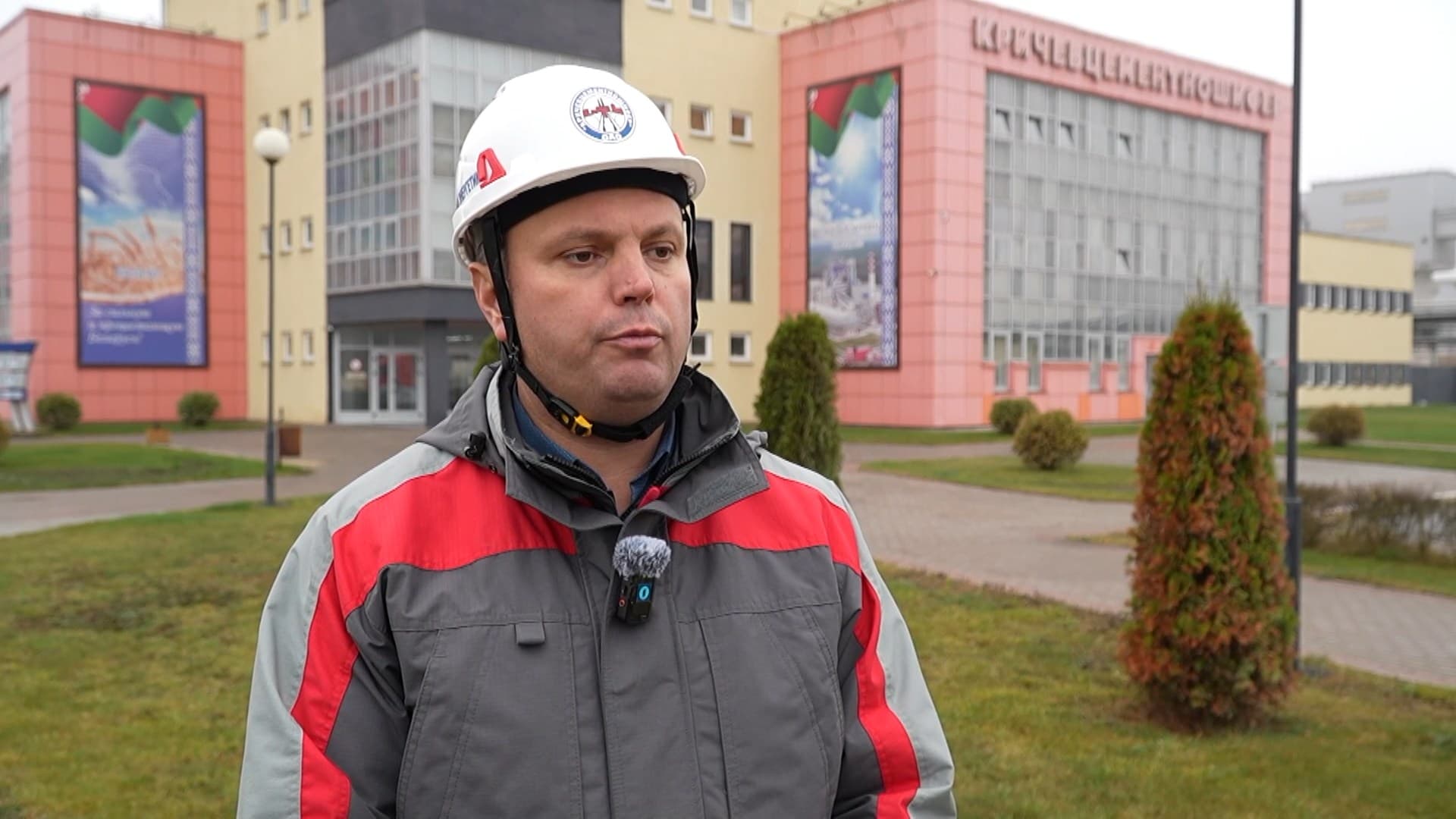
"This is the embodiment of those priorities approved by the 7th All-Belarusian People's Assembly—the development of technologies and the strengthening of the industrial potential of the regions. Our enterprise is focused on ensuring that every ruble invested yields a real result," noted Valentin Ilyinich, delegate to the All-Belarusian People's Assembly and deputy head of the transport and packaging shop at OAO Krichevcementnoshifer.
Among the new investment projects implemented is the modernization of the packaging line: laser marking has been introduced, making it possible to track the product all the way to the end consumer. In addition, 170 Mogilev hopper cars were purchased for cement transportation.
"Currently, as part of the Ecology state program, Krichevcementnoshifer open joint-stock company is implementing an initiative to burn RDF fuel. The implementation of this project will help reduce the ecological burden on the environment by decreasing the volume of municipal solid waste being sent to landfills," explained Vadim Rakitin, Chief Power Engineer of Krichevcementnoshifer OJSC.
Regional Healthcare: Modern Equipment for District Hospitals
Another pressing area is the development of healthcare in the regions, which received support at the All-Belarusian People's Assembly. Thanks to modernization and re-equipment, the Krichev Central District Hospital has become the 16th interdistrict medical center in the country.
The hospital's chief physician, Alexander Pletnev, a delegate to the All-Belarusian People's Assembly, is confident that the decision was the right one: healthcare must be accessible.
Currently, the Krichev Central District Hospital provides care in such areas as surgery, urology, and cardiology; patients with strokes are delivered here, and an angiograph has been installed.
"In October 2026, a mobile feldsher-midwife station was deployed, which goes out daily to remote villages. First of all, this is about caring for rural residents, so that every person, no matter where they are or in what remote village they live, receives comprehensive and competent medical care, as demanded by the Head of our State, Alexander Lukashenko," shared Alexander Pletnev, Chief Physician of the Krichev Central District Hospital and a participant in the 3rd and 6th All-Belarusian People's Assemblies.
Preparation for the All-Belarusian People's Assembly: Regional Development Priorities Defined
Regions must develop evenly, and people should feel the state's care and appreciate safe and comfortable living conditions—another important message from the President.
Alexander Lukashenko, President of Belarus:
In every region and district — that is where we are shifting the centre of gravity, all our forces and resources. The most critical task is to stop the outflow of people from the regions and to relieve the congestion in the capital and regional centres. We must resolve this issue using revolutionary methods, definitively and without debate, otherwise the country will become depopulated, with everything pulled into Minsk and the regional centres. We need to anchor people in agrotowns and major supporting villages, and provide them with a normal life there. In most cases, all of this requires significant financial and time investments; therefore, all programmatic documents (national and regional) must be synchronized, or we will face a massive development imbalance. Top priority must be given to employment and housing — there must be housing and work.
 Retaining specialists: creating conditions for life and work
Thanks to the construction of rental housing (with at least one multi-story residential building commissioned annually in district centres), young specialists are increasingly choosing their home regions to live in.
Over the past couple of years, a dozen doctors in various specialties have settled in the Krichev Central District Hospital. Radiologist Igor Malashchenko speaks positively about the support from management and beyond: "I was provided with rental housing, which is very important. The state's policy is aimed at ensuring that young specialists stay as long as possible, put down roots in their workplaces, and feel comfortable working here. Also, speaking specifically about the Krichev Central District Hospital, I like that diagnostics are very well developed here."
 "A guaranteed workplace is a very correct tactic of our state because all conditions are being created. Right now, the district is developing very well, feldsher-obstetric stations are developing, so, of course, we should be proud of this," noted Daria Belskaya, a pediatrician at the Krichev Central District Hospital.
Rural development: social guarantees and the creation of necessary infrastructure
And this is an outpatient clinic in the agrotown of Bel. If necessary, even medical specialists come out here: on-site ECG, first aid, medications — everything is for the people.
The countryside must live, is the conviction of Igor Rybchinsky, Chairman of the Belsky Rural Executive Committee and delegate to the All-Belarusian People's Assembly: "I fully support the issues raised by the Head of State at the 2nd meeting of the All-Belarusian People's Assembly regarding the development and support of rural areas, encompassing all the tasks and directions outlined by the Head of State. Our government will provide support through programs, allocate funding, lay asphalt, change light bulbs, provide water and food—everything is clear. Where is our help to the state, after all? I urge our compatriots to pay attention to this so that all of us, together with our state, can preserve the countryside."
"All the necessary living conditions have been created in our agrotown. We have a large, spacious school and a kindergarten where children study and develop. This is necessary and must be preserved. An agrotown is not just a dot on the map, but a place where you want to live and raise your children and grandchildren," said Olga Mikhnikova, a resident of the Belsky agrotown.
And there are hundreds of such places across the country. A great deal of effort has been invested to create all the conditions for life in rural areas. Without the countryside, there will be no state. It is important to preserve what has been built over decades.
Sections:
SocietyRegionsTags:
countrysideANPAagrotownAlexander LukashenkoRead also