Menu
""" Budget 2027: How income and expenses are planned """
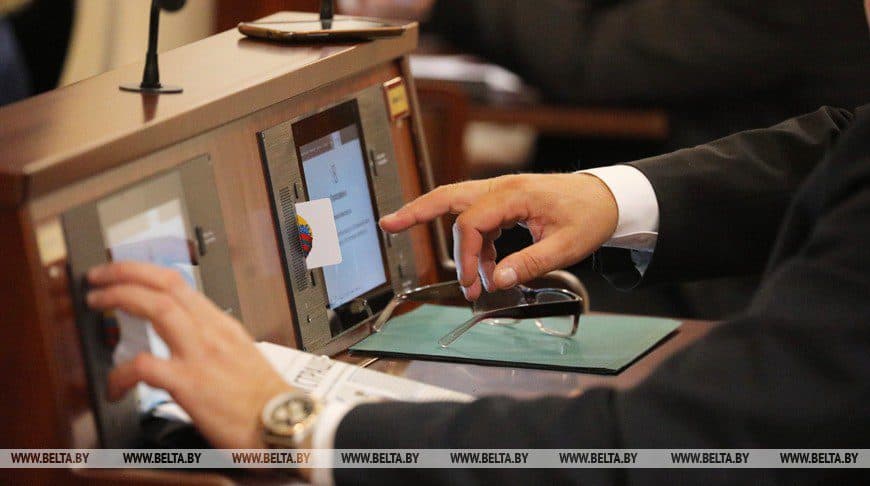
The key challenge for Belarus’s development next year is to ensure macroeconomic stability, financial sustainability, and socially-oriented budget spending to reduce regional disparities in citizens’ living standards and quality of life. Based on this, the national budget for the upcoming financial year has been drawn up. The relevant bill was adopted by MPs in its second reading. When presenting the bill in the Oval Hall, Vasily Panasyuk, Chairman of the Standing Committee on Budget and Finance of the House of Representatives, spoke in detail about the structure of revenues and expenditures.
Total revenues under the draft national budget for 2027 are estimated at around 58 billion 904 million roubles, or 16.5% of GDP. Expenditures are planned at around 60 billion 835 million roubles, or 17% of GDP. The deficit, which will be covered by domestic and external sources, amounts to 1 billion 931 million roubles, or 0.5% of GDP.
Budget revenues
In the area of tax policy, next year will see continuity in achieving previously set goals: ensuring the principle of social justice, creating equal taxation conditions for businesses, optimising administrative procedures, and increasing the rationality and stability of the tax system.
Next year, the largest share of the national budget’s revenues will come from: VAT (44%), revenues from foreign economic activity (14%), excise taxes (6.3%), and profit tax (6%). Non-tax revenues will account for 12.4%.
Budget expenditures
The roadmap for state spending next year is traditionally balanced and maintains a social focus. Budget spending in education is projected at 2 billion 969 million roubles, or an increase of 17%.
Vasily Panasyuk noted that these funds should ensure the achievement of new tasks facing the system, including increasing national competitiveness in the global educational space and giving the state greater resilience in the face- of economic and social transformations. """
""" The healthcare budget policy will focus on promoting healthy lifestyles, integrating new specialized and high-tech medical services, advancing healthcare digitalization, and enhancing the prestige of medical professions. Funding for these initiatives is set at 3.89 billion rubles, a 14.6% increase compared to this year.
The draft budget allocates nearly 4 billion rubles for social policy implementation, a 9% increase from this year’s plans. These funds will support key state priorities in social areas, including family, knowledge economy, regional development, and environmental protection.
“Our core principle remains unchanged: people and their interests are our top priority,” the deputy emphasized. He noted that next year’s socially significant budget expenditures will include family capital payments, state-supported housing construction funding, youth policy support, and centralized procurement of electric and automotive transport for educational, healthcare, and social service institutions.
Given the five-year plan’s focus on roads, the republican road fund’s budget will increase by 11%, reaching approximately 2.5 billion rubles. Capital road repair expenditures will grow even faster, by 1.5 times, totaling 304 million rubles.
To ensure food security and boost the agricultural sector’s export potential, the upcoming budget guarantees funding for agricultural development initiatives. These include expanding agricultural production, fish farming, processing agricultural products, land reclamation, implementing pilot innovative projects, and maintaining a reserve of veterinary drugs.
Vasily Panasyuk noted that deputies actively participated in all stages of the bill’s development, offering comments and suggestions, some of which were incorporated into the budget draft. Several additional suggestions are proposed for implementation in future periods. """